
Plus, receive recommendations and exclusive offers on all of your favorite books and authors from Simon & Schuster.
Table of Contents
About The Book
A taut and chillingly atmospheric debut that signals the arrival of a bright new voice in psychological suspense and "a brilliant analysis of an exceedingly twisted mind" (Chicago Tribune).
Eighteen years ago, Billy Peters disappeared. Everyone in town believes Billy was murdered—after all, serial killer Arnold Avery later admitted killing six other children and burying them on the same desolate moor that surrounds their small English village. Only Billy’s mother is convinced he is alive. She still stands lonely guard at the front window of her home, waiting for her son to return, while her remaining family fragments around her.
But her twelve-year-old grandson Steven is determined to heal the cracks that gape between his nan, his mother, his brother, and himself. Steven desperately wants to bring his family closure, and if that means personally finding his uncle’s corpse, he’ll do it.
Spending his spare time digging holes all over the moor in the hope of turning up a body is a long shot, but at least it gives his life purpose.
Then at school, when the lesson turns to letter writing, Steven has a flash of inspiration...
Careful to hide his identity, he secretly pens a letter to Avery in jail asking for help in finding the body of "W.P."—William "Billy" Peters. So begins a dangerous cat-and-mouse game.
Just as Steven tries to use Avery to pinpoint the gravesite, so Avery misdirects and teases his mysterious correspondent in order to relive his heinous crimes. And when Avery finally realizes that the letters he’s receiving are from a twelve-year-old boy, suddenly his life has purpose too.
Although his is far more dangerous...
Eighteen years ago, Billy Peters disappeared. Everyone in town believes Billy was murdered—after all, serial killer Arnold Avery later admitted killing six other children and burying them on the same desolate moor that surrounds their small English village. Only Billy’s mother is convinced he is alive. She still stands lonely guard at the front window of her home, waiting for her son to return, while her remaining family fragments around her.
But her twelve-year-old grandson Steven is determined to heal the cracks that gape between his nan, his mother, his brother, and himself. Steven desperately wants to bring his family closure, and if that means personally finding his uncle’s corpse, he’ll do it.
Spending his spare time digging holes all over the moor in the hope of turning up a body is a long shot, but at least it gives his life purpose.
Then at school, when the lesson turns to letter writing, Steven has a flash of inspiration...
Careful to hide his identity, he secretly pens a letter to Avery in jail asking for help in finding the body of "W.P."—William "Billy" Peters. So begins a dangerous cat-and-mouse game.
Just as Steven tries to use Avery to pinpoint the gravesite, so Avery misdirects and teases his mysterious correspondent in order to relive his heinous crimes. And when Avery finally realizes that the letters he’s receiving are from a twelve-year-old boy, suddenly his life has purpose too.
Although his is far more dangerous...
Reading Group Guide
Get a FREE ebook by joining our mailing list today! Plus, receive recommendations for your next Book Club read.
By clicking 'Sign me up' I agree to the Terms of Use and acknowledge the Privacy Policy and Notice of Financial Incentive. Free ebook offer available to NEW US subscribers only. Offer redeemable at Simon & Schuster's ebook fulfillment partner. Must redeem within 90 days. See full terms and conditions and this month's choices.
This reading group guide for Blacklands includes an introduction, discussion questions, ideas for enhancing your book club, and a Q&A with author Belinda Bauer. The suggested questions are intended to help your reading group find new and interesting angles and topics for your discussion. We hope that these ideas will enrich your conversation and increase your enjoyment of the book.
INTRODUCTION
Steven Lamb is on a mission: to find the buried body of his uncle Billy, one of several children murdered nineteen years ago. Steven is certain that finding the remains of his uncle is the key to healing the wounds in his severely fragmented family and easing the tension between his mother and his nan. After three years of luckless digging, he turns to the one person who can help his cause—Billy’s suspected killer, the imprisoned Arnold Avery. What begins as a cryptic correspondence between two strangers quickly turns into an enthralling game of cat and mouse, as Avery realizes that the person asking him for clues is the object of his greatest desire: a child.
With thrilling and heartfelt turns, Belinda Bauer crafts a taut novel of suspense that looks closely at what happens when the cloud of tragedy hangs over a family—and how far a young boy is willing to go to try to fix everything.
TOPICS AND QUESTIONS FOR DISCUSSION
1. How does the earth play into the story’s narrative? Consider Steven’s tireless digging on the moor, Arnold Avery’s obsession with Dunkery Beacon, Steven and Uncle Jude’s backyard garden, and the final scene on the foggy Blacklands.
2. At what point does Steven stop being a child? Has he lost some fundamental aspect of his innocence and adolescence to the weight of history?
3. Should the family and authorities have done more to find Billy’s body? What resolution could come from finding his remains? What does that change?
4. Was there a point at which you sympathized with Arnold Avery? Is there any redemption for his character?
5. What is the nature of fear throughout the book? How is Steven’s fear of “the hoodies” different from his fear of Avery? What do you think makes Steven refuse to flee the Blacklands and instead face his uncle’s killer?
6. Did you expect Avery to escape from prison? At what point did Avery and Steven’s correspondence begin to foreshadow a faceto- face encounter?
7. Did the use of actual letters within the text enhance the story? Did you find yourself reading meaning into Avery’s capitalizations?
8. Which of Avery’s obsessions in prison were most disturbing? Seeing pictures of the moor? Playing games with his victims’ families? Or building benches with engraved plaques?
9. The details of Avery’s demise on the Blacklands are inexact. How do you think the scene played out? Consider the involvement of Nan, Steven, Lettie, and Lewis’s father.
10. Do you see any significance in Mason Dingle’s son being the one to shoot Avery?
11. Do you think it’s possible that Steven and his family can return to a normal life? Can their fragmented family heal?
12. Will the changed environment in the household allow Uncle Jude to return and stick around? How do you think each character (Steven, Davey, Nan, Lettie) will be affected by the revelations at story’s end?
ENHANCE YOUR BOOK CLUB
1. Try writing a series of short letters to a friend or family member. See if you can code hidden information into symbols and drawings.
2. Read a comparable thriller (try Richard Doetsch’s The 13th Hour) and see how the energy, tension, and anxiety of the narrative compares to Blacklands. How do they differ?
3. Where do you find the sense of urgency/intrigue begins in each? Visit your library and do some archival research on a local crime. Is there anything left unsolved? Could you see someone being inspired to resolve these open endings?
4. For those near some sort of elevated land, take a trip to your nearest “moor” or similar area. Read a passage of the book when you arrive. Does the land seem ripe for secrets? Could something terrible be buried under the earth around you?
5. In the spirit of Steven and Uncle Jude, plant a backyard garden and see if you can sustain the crops through the seasons.
A CONVERSATION WITH BELINDA BAUER
Arnold Avery is an incredibly depraved individual. Was there ever a moment you felt uncomfortable writing him? Were his sordid desires and memories difficult to articulate? What’s it like to take on the mind of a child killer?
Once I realized that Avery doesn’t feel that what he is doing is wrong, I found him easy to write. His overriding characteristic is his lack of empathy, so he genuinely doesn’t have any concept of, or interest in, other people’s feelings. Every time I wrote from Avery’s point of view, all I had to do was drop the empathy. It was a cold experience but fascinating to imagine the world through such selfish eyes—it’s a very different place. The scene I wrote where Steven has a sudden insight into Avery’s mind was the thing I found most uncomfortable to write, because it has its own horrible logic, but comes from inside someone who does have empathy. It scared Steven that he could grasp that—and that was the one point where it scared me too.
By that same token, is Avery a complete sociopath? Is there any redemption for a man like that?
Personally, I don’t feel there is any redemption for Avery. There is something broken in his psyche that currently we have no way to fix or replace.
The use of scanned letters extended the prose into a more realistic territory. What made you decide to use these images? Who penned Steven’s and Avery’s notes?
My editor suggested we have handwritten notes, and I think it was a great idea because it personalizes Steven so much. His notes were written by a friend’s son, Jack Cryer, who was a similar age. I researched the graphology of serial killers and sociopaths and wrote Avery’s notes myself.
In your author’s note, you mention that Avery’s escape over the Longmoor wall was inspired by a real prison break. What other research did you do for the novel? Are Avery’s crimes and burial methods something you thought up, or is there a real-world basis?
Apart from the handwriting, the prison was the major research I undertook for Blacklands. I was not allowed into Dartmoor Prison, which is the model for Longmoor, but I was lucky enough to find someone who knew the prison intimately. The moment he mentioned the real-life prison break, I knew I had to use it. From that came the whole scenario of Avery making benches, and I think the plaques he puts on them are a chilling touch, so that research was a real piece of luck. I also did some research into the army and their use of the firing ranges on the moor. It’s amazing—you do days or weeks of research and then use only a few small bits of it in the book, but they really do count. Avery’s crimes are based on the Moors Murders of 1960s Britain.
The child victims were buried on the Yorkshire moors and one of them, Keith Bennett, has never been found. It was the thought of the agony this must still be causing to his family that sparked the idea for Blacklands.
For those of us not able to jump continents are the sprawling moors and quaint towns you included in Blacklands actual places? Did you try to depict them realistically, or did you take liberties to add dimension to the story?
Blacklands is a real area on Exmoor, but Shipcott is a fabrication. In my head I know vaguely where it would be on the moor, but it’s handy to make it slightly fluid so no geek can pin me down on geography and claim the village would be in the middle of a bog or something!
To what purpose did you involve Mason Dingle’s son (and his heavy trigger finger) during Avery’s escape? Was it supposed to be biting coincidence, or are there larger implications?
Almost as soon as I thought of that scene, I thought of Mason Dingle. I loved his character and felt I’d like to see him again. I also relished the coincidence. Life is full of crazy coincidences and weird overlaps, and this one hardly impinges on the outcome, so I don’t feel it is cheating. Blacklands is all about the effect of crimes on people through the generations, and I love the irony of Mason Dingle’s son being as much a victim of that as anybody, despite his ambition to escape. I know some readers have thought the scene was an afterthought and sticks out like a sore thumb, but I really like exploring every character—even those who only make a fleeting appearance—in my books. If they intersect with other characters and affect them or the plot, then I like to know why they do what they do.
What advice would you give someone with a family tragedy or secret like Steven’s? Should we all be as persistent, or is there a point at which one should give in to the weight of history and let it be?
I am lucky enough never to have been affected by such a tragedy. My only tool is my imagination, and I can imagine situations where both courses of action would be advisable. I guess that when something terrible happens, you respond to it the only way you can, and make the best of it that you can. Steven is probably extraordinary— but that’s why he’s my hero! Steven’s toiling on the moor is beautifully and realistically rendered.
Have you ever done any digging of your own?
No. I would have given up looking for the body of Uncle Billy at about the time Lewis did! But for Steven it’s his only hope of repairing his family; there is nothing else in his life, so I was completely behind his decision to keep going.
How is writing a prose narrative different from writing for film? Is there one that you’re more comfortable with? Could Blacklands translate to the screen?
With prose you really have to relax and enjoy yourself. Screenwriting is a far more dictatorial discipline, and you’re always compromising on time and space. Now that I’ve made the switch, I have little desire to go back to screenwriting, although it was an excellent preparation for novel writing, as I think it means there’s little padding in my books. I get impatient with padding! My original idea for Blacklands was to write it as a film, so I would love to see it on the screen someday.
Are you working on another novel? If so, is it set to be a thriller? (Or can you see it transforming into such, as was the case with Blacklands?)
I have just finished my second book, a crime thriller called Darkside, which is also set in Shipcott, but is a stand-alone story.
INTRODUCTION
Steven Lamb is on a mission: to find the buried body of his uncle Billy, one of several children murdered nineteen years ago. Steven is certain that finding the remains of his uncle is the key to healing the wounds in his severely fragmented family and easing the tension between his mother and his nan. After three years of luckless digging, he turns to the one person who can help his cause—Billy’s suspected killer, the imprisoned Arnold Avery. What begins as a cryptic correspondence between two strangers quickly turns into an enthralling game of cat and mouse, as Avery realizes that the person asking him for clues is the object of his greatest desire: a child.
With thrilling and heartfelt turns, Belinda Bauer crafts a taut novel of suspense that looks closely at what happens when the cloud of tragedy hangs over a family—and how far a young boy is willing to go to try to fix everything.
TOPICS AND QUESTIONS FOR DISCUSSION
1. How does the earth play into the story’s narrative? Consider Steven’s tireless digging on the moor, Arnold Avery’s obsession with Dunkery Beacon, Steven and Uncle Jude’s backyard garden, and the final scene on the foggy Blacklands.
2. At what point does Steven stop being a child? Has he lost some fundamental aspect of his innocence and adolescence to the weight of history?
3. Should the family and authorities have done more to find Billy’s body? What resolution could come from finding his remains? What does that change?
4. Was there a point at which you sympathized with Arnold Avery? Is there any redemption for his character?
5. What is the nature of fear throughout the book? How is Steven’s fear of “the hoodies” different from his fear of Avery? What do you think makes Steven refuse to flee the Blacklands and instead face his uncle’s killer?
6. Did you expect Avery to escape from prison? At what point did Avery and Steven’s correspondence begin to foreshadow a faceto- face encounter?
7. Did the use of actual letters within the text enhance the story? Did you find yourself reading meaning into Avery’s capitalizations?
8. Which of Avery’s obsessions in prison were most disturbing? Seeing pictures of the moor? Playing games with his victims’ families? Or building benches with engraved plaques?
9. The details of Avery’s demise on the Blacklands are inexact. How do you think the scene played out? Consider the involvement of Nan, Steven, Lettie, and Lewis’s father.
10. Do you see any significance in Mason Dingle’s son being the one to shoot Avery?
11. Do you think it’s possible that Steven and his family can return to a normal life? Can their fragmented family heal?
12. Will the changed environment in the household allow Uncle Jude to return and stick around? How do you think each character (Steven, Davey, Nan, Lettie) will be affected by the revelations at story’s end?
ENHANCE YOUR BOOK CLUB
1. Try writing a series of short letters to a friend or family member. See if you can code hidden information into symbols and drawings.
2. Read a comparable thriller (try Richard Doetsch’s The 13th Hour) and see how the energy, tension, and anxiety of the narrative compares to Blacklands. How do they differ?
3. Where do you find the sense of urgency/intrigue begins in each? Visit your library and do some archival research on a local crime. Is there anything left unsolved? Could you see someone being inspired to resolve these open endings?
4. For those near some sort of elevated land, take a trip to your nearest “moor” or similar area. Read a passage of the book when you arrive. Does the land seem ripe for secrets? Could something terrible be buried under the earth around you?
5. In the spirit of Steven and Uncle Jude, plant a backyard garden and see if you can sustain the crops through the seasons.
A CONVERSATION WITH BELINDA BAUER
Arnold Avery is an incredibly depraved individual. Was there ever a moment you felt uncomfortable writing him? Were his sordid desires and memories difficult to articulate? What’s it like to take on the mind of a child killer?
Once I realized that Avery doesn’t feel that what he is doing is wrong, I found him easy to write. His overriding characteristic is his lack of empathy, so he genuinely doesn’t have any concept of, or interest in, other people’s feelings. Every time I wrote from Avery’s point of view, all I had to do was drop the empathy. It was a cold experience but fascinating to imagine the world through such selfish eyes—it’s a very different place. The scene I wrote where Steven has a sudden insight into Avery’s mind was the thing I found most uncomfortable to write, because it has its own horrible logic, but comes from inside someone who does have empathy. It scared Steven that he could grasp that—and that was the one point where it scared me too.
By that same token, is Avery a complete sociopath? Is there any redemption for a man like that?
Personally, I don’t feel there is any redemption for Avery. There is something broken in his psyche that currently we have no way to fix or replace.
The use of scanned letters extended the prose into a more realistic territory. What made you decide to use these images? Who penned Steven’s and Avery’s notes?
My editor suggested we have handwritten notes, and I think it was a great idea because it personalizes Steven so much. His notes were written by a friend’s son, Jack Cryer, who was a similar age. I researched the graphology of serial killers and sociopaths and wrote Avery’s notes myself.
In your author’s note, you mention that Avery’s escape over the Longmoor wall was inspired by a real prison break. What other research did you do for the novel? Are Avery’s crimes and burial methods something you thought up, or is there a real-world basis?
Apart from the handwriting, the prison was the major research I undertook for Blacklands. I was not allowed into Dartmoor Prison, which is the model for Longmoor, but I was lucky enough to find someone who knew the prison intimately. The moment he mentioned the real-life prison break, I knew I had to use it. From that came the whole scenario of Avery making benches, and I think the plaques he puts on them are a chilling touch, so that research was a real piece of luck. I also did some research into the army and their use of the firing ranges on the moor. It’s amazing—you do days or weeks of research and then use only a few small bits of it in the book, but they really do count. Avery’s crimes are based on the Moors Murders of 1960s Britain.
The child victims were buried on the Yorkshire moors and one of them, Keith Bennett, has never been found. It was the thought of the agony this must still be causing to his family that sparked the idea for Blacklands.
For those of us not able to jump continents are the sprawling moors and quaint towns you included in Blacklands actual places? Did you try to depict them realistically, or did you take liberties to add dimension to the story?
Blacklands is a real area on Exmoor, but Shipcott is a fabrication. In my head I know vaguely where it would be on the moor, but it’s handy to make it slightly fluid so no geek can pin me down on geography and claim the village would be in the middle of a bog or something!
To what purpose did you involve Mason Dingle’s son (and his heavy trigger finger) during Avery’s escape? Was it supposed to be biting coincidence, or are there larger implications?
Almost as soon as I thought of that scene, I thought of Mason Dingle. I loved his character and felt I’d like to see him again. I also relished the coincidence. Life is full of crazy coincidences and weird overlaps, and this one hardly impinges on the outcome, so I don’t feel it is cheating. Blacklands is all about the effect of crimes on people through the generations, and I love the irony of Mason Dingle’s son being as much a victim of that as anybody, despite his ambition to escape. I know some readers have thought the scene was an afterthought and sticks out like a sore thumb, but I really like exploring every character—even those who only make a fleeting appearance—in my books. If they intersect with other characters and affect them or the plot, then I like to know why they do what they do.
What advice would you give someone with a family tragedy or secret like Steven’s? Should we all be as persistent, or is there a point at which one should give in to the weight of history and let it be?
I am lucky enough never to have been affected by such a tragedy. My only tool is my imagination, and I can imagine situations where both courses of action would be advisable. I guess that when something terrible happens, you respond to it the only way you can, and make the best of it that you can. Steven is probably extraordinary— but that’s why he’s my hero! Steven’s toiling on the moor is beautifully and realistically rendered.
Have you ever done any digging of your own?
No. I would have given up looking for the body of Uncle Billy at about the time Lewis did! But for Steven it’s his only hope of repairing his family; there is nothing else in his life, so I was completely behind his decision to keep going.
How is writing a prose narrative different from writing for film? Is there one that you’re more comfortable with? Could Blacklands translate to the screen?
With prose you really have to relax and enjoy yourself. Screenwriting is a far more dictatorial discipline, and you’re always compromising on time and space. Now that I’ve made the switch, I have little desire to go back to screenwriting, although it was an excellent preparation for novel writing, as I think it means there’s little padding in my books. I get impatient with padding! My original idea for Blacklands was to write it as a film, so I would love to see it on the screen someday.
Are you working on another novel? If so, is it set to be a thriller? (Or can you see it transforming into such, as was the case with Blacklands?)
I have just finished my second book, a crime thriller called Darkside, which is also set in Shipcott, but is a stand-alone story.
About The Author
Johnny Ring
Belinda Bauer grew up in England and South Africa. She has worked as a journalist and screenwriter, and her script The Locker Room earned her the Carl Foreman/Bafta Award for Young British Screenwriters, an award that was presented to her by Sidney Poitier. She was a runner-up in the Rhys Davies Short Story Competition for “Mysterious Ways,” about a girl stranded on a desert island with 30,000 Bibles. Belinda now lives in Wales. Her latest novel, Snap, was longlisted for the Man Booker Prize.
Product Details
- Publisher: Simon & Schuster (January 11, 2011)
- Length: 240 pages
- ISBN13: 9781439149454
Browse Related Books
Raves and Reviews
“Blacklands is leading the pack of profound new mysteries. . . . Atmospheric . . . . bewitching . . . . a brilliant analysis of an exceedingly twisted mind.”
—Chicago Tribune
“Bauer’s ability to shift between the perspective of a 12-year-old boy and a middle-age serial killer is brilliant and frightening all at once. . . . [her] debut novel promises to be the first of many good reads.”
—The Post and Courier (Charleston, SC)
Resources and Downloads
High Resolution Images
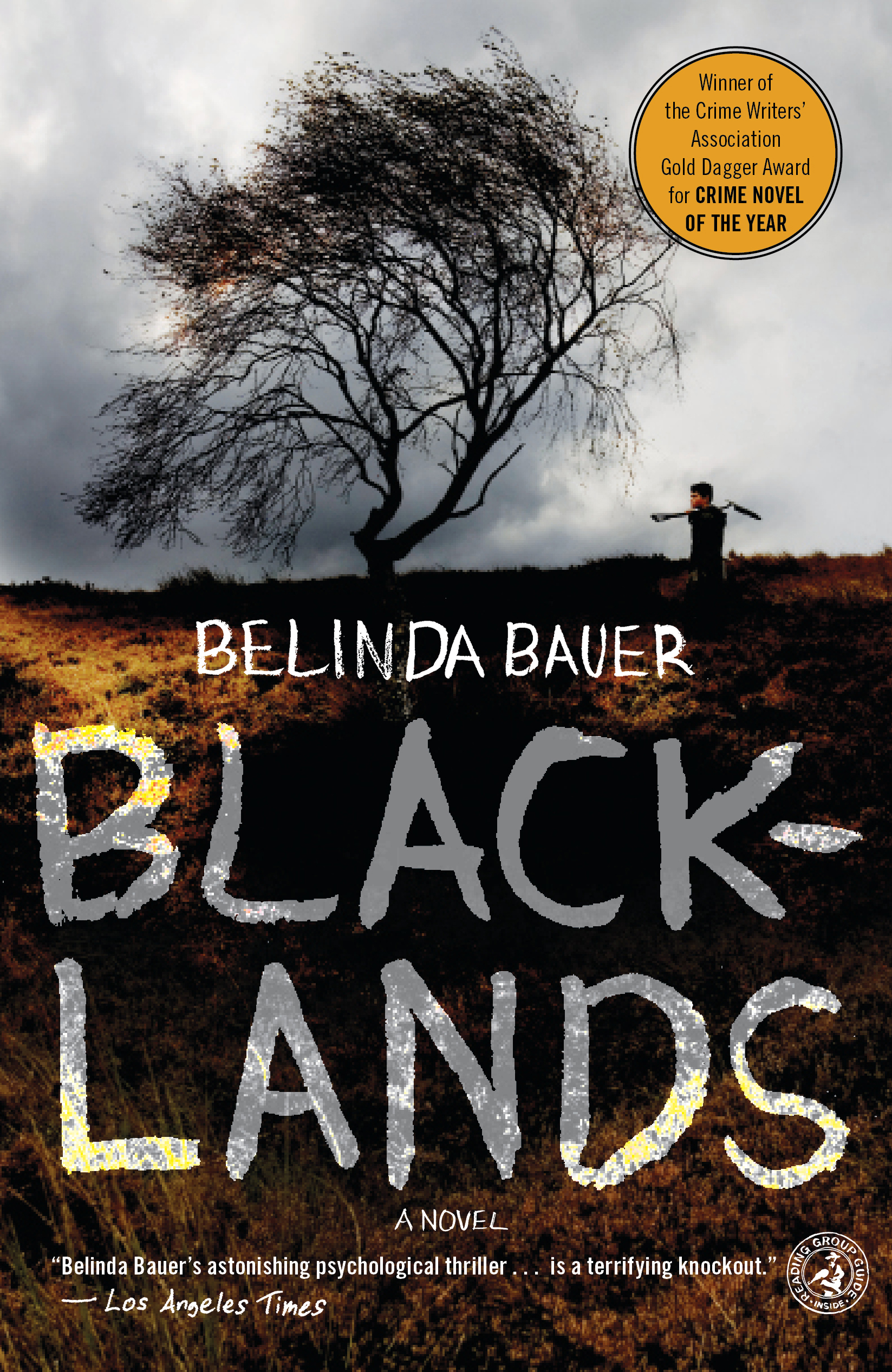
- Book Cover Image (jpg): Blacklands Trade Paperback 9781439149454(3.1 MB)
- Author Photo (jpg): Belinda Bauer Johnny Ring(0.4 MB)
Any use of an author photo must include its respective photo credit