

Plus, receive recommendations and exclusive offers on all of your favorite books and authors from Simon & Schuster.
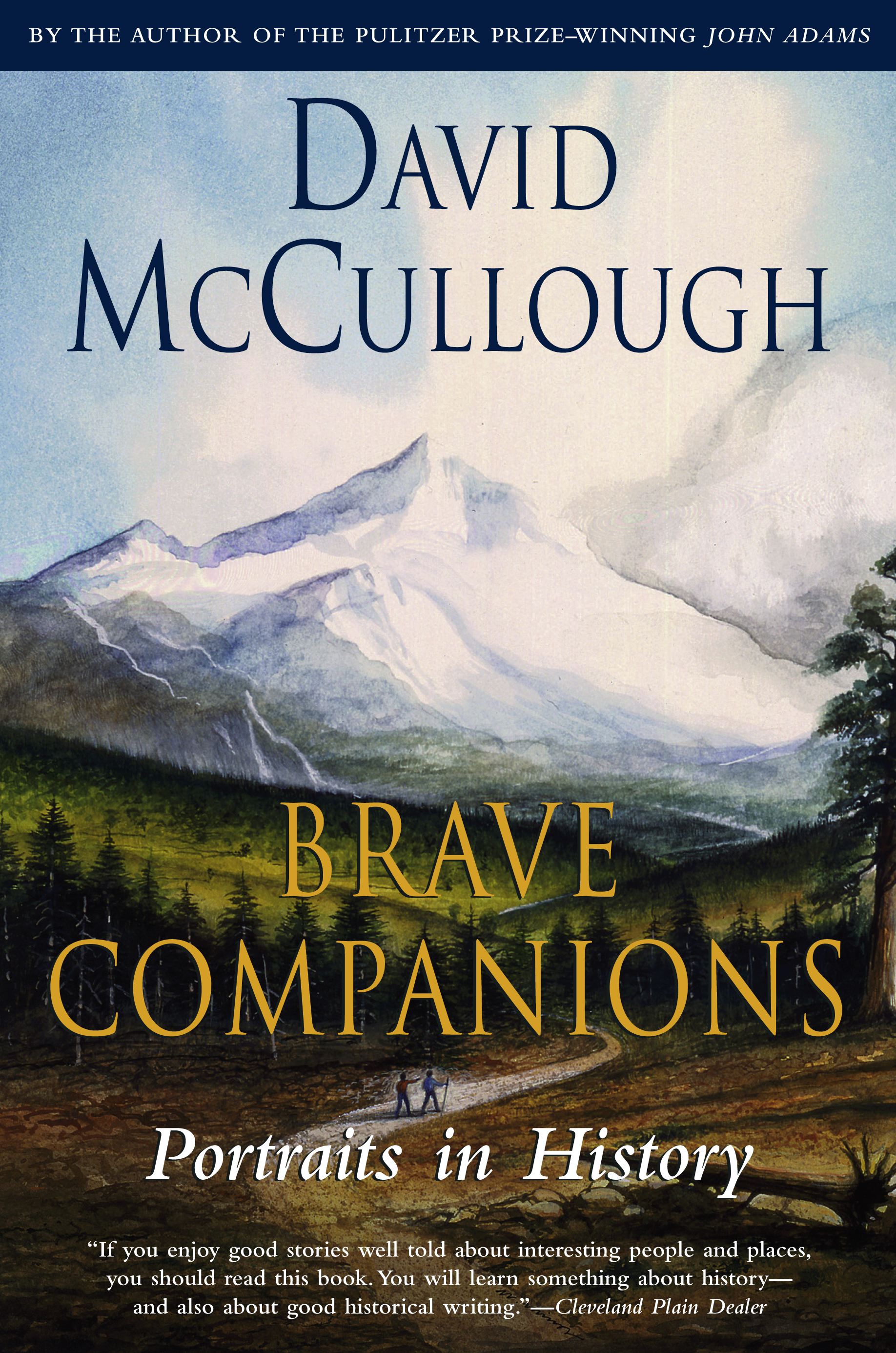
Brave Companions
Table of Contents
About The Book
From Alexander von Humboldt to Charles and Anne Lindbergh, these are stories of people of great vision and daring whose achievements continue to inspire us today, brilliantly told by master historian David McCullough.
The bestselling author of Truman and John Adams, David McCullough has written profiles of exceptional men and women past and present who have not only shaped the course of history or changed how we see the world but whose stories express much that is timeless about the human condition.
Here are Alexander von Humboldt, whose epic explorations of South America surpassed the Lewis and Clark expedition; Harriet Beecher Stowe, “the little woman who made the big war”; Frederic Remington; the extraordinary Louis Agassiz of Harvard; Charles and Anne Lindbergh, and their fellow long-distance pilots Antoine de Saint-Exupéry and Beryl Markham; Harry Caudill, the Kentucky lawyer who awakened the nation to the tragedy of Appalachia; and David Plowden, a present-day photographer of vanishing America.
Different as they are from each other, McCullough’s subjects have in common a rare vitality and sense of purpose. These are brave companions: to each other, to David McCullough, and to the reader, for with rare storytelling ability McCullough brings us into the times they knew and their very uncommon lives.
The bestselling author of Truman and John Adams, David McCullough has written profiles of exceptional men and women past and present who have not only shaped the course of history or changed how we see the world but whose stories express much that is timeless about the human condition.
Here are Alexander von Humboldt, whose epic explorations of South America surpassed the Lewis and Clark expedition; Harriet Beecher Stowe, “the little woman who made the big war”; Frederic Remington; the extraordinary Louis Agassiz of Harvard; Charles and Anne Lindbergh, and their fellow long-distance pilots Antoine de Saint-Exupéry and Beryl Markham; Harry Caudill, the Kentucky lawyer who awakened the nation to the tragedy of Appalachia; and David Plowden, a present-day photographer of vanishing America.
Different as they are from each other, McCullough’s subjects have in common a rare vitality and sense of purpose. These are brave companions: to each other, to David McCullough, and to the reader, for with rare storytelling ability McCullough brings us into the times they knew and their very uncommon lives.
Excerpt
Chapter 1
Journey to the Top of the World
On a morning in May 1804, there arrived at the White House by Baltimore coach, and in the company of the painter Charles Willson Peale, a visitor from abroad: an aristocratic young German, age thirty-four, a bachelor, occupation scientist and explorer. And like Halley's comet or the white whale or other such natural phenomena dear to the nineteenth century, he would be remembered by all who saw him for the rest of their days.
He had come to pay his respects to the president of the new republic, Thomas Jefferson, a fellow "friend of science," and to tell him something of his recent journeys through South and Central America. For the next several weeks he did little else but talk, while Jefferson, on their walks about the White House grounds; or James Madison, the secretary of state; or the clever Mrs. Madison; or Albert Gallatin, the secretary of the treasury; or those who came to dine with the president or to do business with him, listened in awe.
The young man, they found, was a naturalist, an astronomer, a geographer, a geologist, a botanist, an authority on Indian antiquities, a linguist, an artist -- an academy unto himself, as the poet Goethe would say. He was at home in any subject. He had read every book. He had seen things almost impossible to imagine. "We all consider him as a very extraordinary man," Gallatin told his wife, speaking apparently for Jefferson's entire official family, "and his travels, which he intends publishing on his return to Europe, will, I think, rank above any other productions of the kind." He also talked at double the speed of anybody Gallatin had ever met before and would shift suddenly from English, which he spoke superbly, into French or Spanish or German, seemingly unaware of what he was doing, but never hesitating for a word, apparently to the very great confusion of his newfound American friends, Jefferson and the Swiss-born Gallatin not included.
Gallatin, a man not easily impressed, found the extent of the visitor's reading and scientific knowledge astonishing. "I was delighted," he said, "and swallowed more information of various kinds in less than two hours than I had for two years past in all I had read and heard."
In a letter to Jefferson written from Philadelphia a few days earlier, the young man had said, "[I would] love to talk to you about a subject that you have treated so ingeniously in your work on Virginia, the teeth of mammoth, which we too discovered in the Andes." Jefferson had responded immediately and most cordially. "A lively desire will be felt generally to receive the information you will be able to give." In the new capital city, Jefferson wrote, there was "nothing curious to attract the observations of a traveler," which was largely so, save, of course, for Jefferson himself. Upon arrival the young man had found the presidential mansion anything but imposing -- crude wooden steps led to the front door, rooms were still unplastered -- and at one point he had inadvertently encountered the chief executive sprawled on the floor, wrestling with his grandchildren.
But there they were in Washington for several days, two of the most remarkable men of their time, fellow spirits if ever there were, talking, talking endlessly, intensely, their conversation having quickly ranged far from fossil teeth.
The young man's name was Humboldt, Alexander von Humboldt -- Friedrich Wilhelm Karl Heinrich Alexander von Humboldt -- or Baron von Humboldt, as he was commonly addressed. He had been born in Berlin on September 14, 1769, the second son of a middle-aged army officer, a minor figure in the court of Frederick the Great, and of a rather solemn, domineering young woman of Huguenot descent who had inherited a sizable fortune. He was a baron in about the way some Southerners are colonels.
William Burwell, Jefferson's private secretary, described him as looking considerably younger than his age, "of small figure, well made, agreeable looks, simple unaffected manners, remarkably sprightly." And Humboldt's passport, issued in Paris in 1798, has him five feet, eight inches tall, with "light-brown hair, gray eyes, large nose, rather large mouth, well-formed chin, open forehead marked by smallpox." However, in a portrait by Peale, done shortly after the trip to see Jefferson, the eyes are as blue as Dutch tiles.
Years later, when the phenomenon of Humboldt had become known the world over, the learned and curious would journey thousands of miles for the chance to see him, and his published works would be taken as the gospel of a new age. He would be regarded as the incomparable high priest of nineteenth-century science -- a towering godlike inspiration to such a disparate assortment of individuals as John Charles Frémont, John James Audubon, John Lloyd Stephens, Sir Charles Lyell, Simón Bolívar, W. H. Hudson, William Hickling Prescott, Edward Whymper, Charles Darwin, Louis Agassiz. Darwin, during the voyage of the Beagle, would carry with him three inspirational books -- the Bible, Milton, and Humboldt.
But at this point the name Humboldt meant very little. The honorary citizenships, the countless decorations, were all still to come. No Pacific Ocean current, no bay or glacier or river had been named for him as yet, no mountains in China. Humboldt, Kansas, and Humboldt, Iowa, were still prairie grass, part of that incomprehensibly vast piece of the continent purchased by Jefferson from Napoleon only the year before and that Jefferson had just sent Meriwether Lewis and William Clark to investigate. So it was the young man himself, not a reputation, and the story he had to tell that captivated everyone. After nearly five years he had returned from one of the great scientific odysseys of all time. It was a journey that would capture the imagination of the age, but that has been strangely forgotten in our own time. It is doubtful that one educated American in ten today could say who exactly Humboldt was or what he did, not even, possibly, in Humboldt, Iowa, or Humboldt, Kansas. Perhaps this is because his travels were through Spanish America. Perhaps his extraordinary accomplishments were simply overshadowed by the popular impact of the Lewis and Clark expedition. In any event, his was a journey of enormous scientific consequence (far more so than the Lewis and Clark expedition) and a fascinating adventure by any standards.
In the company of a young French medical doctor turned botanist, Aime Bonpland, Humboldt had departed from La Coruña, Spain, in June 1799, on a Spanish frigate, slipping past a British blockade in the dark of night, in the midst of a storm, and carrying with him a unique document from the Spanish government. He and Bonpland had been granted complete freedom to explore -- for scientific purposes -- any or all of Spain's largely unexplored American colonies; to make astronomical observations, maps; to collect; to go wherever they wished, speak to whomever they wished. The whole arrangement was quite unprecedented (prior to this Spain had rigorously denied any such travels by foreigners), and it had come about quite by chance.
Humboldt, after completing his education and serving as a government inspector of mines in Prussia, had decided to lead his own far-flung scientific expedition. Just where was an open question, but both of his parents had died, with the result that he had become a man of ample private means and was free to do whatever he wished. His impulse had been to go to Egypt, to catch up with Napoleon's troops there. But he and Bonpland (whom he had met by chance in Paris) had proceeded no farther than Spain when Humboldt, during an audience with Charles IV, expressed an interest in His Catholic Majesty's overseas empire. An expedition, to be paid for by Humboldt, was immediately and most unexpectedly sanctioned, and the two young men were on their way.
The ship followed Columbus's route, going first to the Canary Islands, and though it was Humboldt's intention to commence his scientific discovery of the New World at Cuba, the Spanish captain, after an outbreak of typhoid fever on board, decided to put the two explorers ashore at Cumaná, on the coast of present-day Venezuela, or New Granada, as it was then known.
They landed, bag and baggage, on July 16. Their gear included forty-odd scientific instruments, the most versatile and finest available at the time and just the sort of thing Thomas Jefferson would have found fascinating. Included were a tiny, two-inch sextant (a so-called snuffbox sextant), compasses, a microscope, barometers and thermometers that had been standardized with those of the Paris observatory before departure, three different kinds of electrometers, a device for measuring the specific gravity of seawater, telescopes, a theodolite, a Leyden jar, an instrument by which the blueness of the sky could be determined, a large and cumbersome magnetometer, and a rain gauge. Their excitement was enormous. No botanist, no naturalist or scientist of any kind, had ever been there before them. Everything was new, even the stars in the sky. "We are here in a divine country," Humboldt wrote to his brother. "What trees! Coconut trees, fifty to sixty feet high, Poinciana pulcherrima, with a foot-high bouquet of magnificent, bright-red flowers; pisang and a host of trees with enormous leaves and scented flowers, as big as the palm of a hand, of which we knew nothing...And what colors in birds, fish, even crayfish (sky blue and yellow)! We rush around like the demented; in the first three days we were quite unable to classify anything; we pick up one object to throw it away for the next. Bonpland keeps telling me that he will go mad if the wonders do not cease soon."
And then they were on the move. For three months they explored and mapped the coastal plain, collecting some sixteen hundred plants -- palms, orchids, grasses, bamboos -- among which they were able to identify six hundred new species. They witnessed a total eclipse, an earthquake, and, on a night in November, a spectacular meteor shower that went on for hours. They paddled up the Apure River to its confluence with the Orinoco and there commenced what was to be their major effort: they would trace the Orinoco to its source, something no one had done before, and establish that there is a connection, by the Rio Negro, between the Orinoco and the Amazon.
In all -- on the Apure, the Orinoco, the Atabapo, the Negro, and Casiquiare -- they spent seventy-five days in open boats or canoes, traveling an estimated 6,443 miles through one of the most difficult and little-known places on Earth. Sometimes, on the Casiquiare, for example, they could make almost no headway against the current, they and their Indian guides rowing strenuously for fourteen hours to go all of nine miles. The smothering humidity and torrential rains destroyed most of their provisions. For weeks they lived on bananas and ants, or an occasional fried monkey.
They went as far as Esmeralda, a tiny mosquito-infested village, which Humboldt put on his map and which, curiously, remains on most every map of South America to this day despite the fact that there is no longer a single trace of the place. By September 1, 1800, when they again reached Cumaná, they had beheld, examined, sketched, collected, and classified more plants than any botanist before them (some twelve thousand, by their count). They had gathered rock samples, fishes and reptiles placed in phials, the skins of animals -- enough in fact to keep Humboldt occupied for the rest of his life. Yet they had been barely able to collect a tenth of what they had seen, and the humidity and insects had destroyed more than a third of what they had in their plant boxes.
They themselves, miraculously, held up very well. For two such thoroughly inexperienced, ill-prepared young Europeans to have plunged ahead as they did, knowing nothing of life in the jungle, virtually unequipped by modern standards, had been both amazingly presumptuous and reckless. Bonpland did not even know how to swim. Yet they withstood the broiling climate and every other kind of tropical discomfort with little more to protect them than their own "cheerful character," as Humboldt noted. "With some gaiety of temper," he said, "with feelings of mutual good will, and with a vivid taste for the majestic grandeur of these vast valleys of rivers, travelers easily supported evils that become habitual." The mosquitoes he described as being an atmosphere unto themselves, covering the face, the hands, filling the nostrils. Invariably, he said, they "occasion coughing and sneezing whenever any attempt is made to speak in the open air" -- terrible punishment for someone who so loved to talk.
To avoid the suffocating heat, he and Bonpland often started the day at two in the morning. Their only salvation from the mosquitoes was to bury themselves in sand.
Toward the end of their journey back down the Orinoco, both men came down with typhoid fever. Bonpland very nearly died, but Humboldt, who had been troubled by ill health most of his life, made a rapid recovery and except for that one instance remained perfectly fit throughout, healthier than at any time in his life. He seemed made for the tropics. The days were never long enough. His spirits soared. This for him was life at its fullest and best. "I could not possibly have been placed in circumstances more highly favorable for study and exploration," he wrote to his brother. "I am free from the distractions constantly arising in civilized life from social claims. Nature offers unceasingly the most novel and fascinating objects for learning."
He believed, this brilliant, determined young man being eaten alive by mosquitoes, that there is a harmony of nature, that man is a part of that harmony, and that if he himself could observe things closely enough, collect enough -- if he knew enough -- then the forces that determine that harmony would become apparent.
Nothing seems to have escaped his notice. His physical energy was boundless -- incredible really. Literally everything seems to have interested him. He sketched, he made astronomical observations, magnetic observations. He gathered up rocks and minerals and Indian artifacts. Above all, he kept the most copious notes imaginable -- on tides, soils, petroleum, chocolate, rubber; on missionaries; on the physique of the Carib Indian, the anatomy of shellfish; on turtle eggs, howling monkeys, alligators (one found sunning itself on a sandbank on the Orinoco measured twenty-two feet); on vampire bats and poison darts and electric eels (wonder of wonders); on the nighttime cacophony of the jungle and the sudden silence imposed by the roar of the jaguar (an observation that would intrigue Audubon); on a tribe of Indians, the Otomaco, that overcame annual seasons of famine by eating a particular kind of dirt; on a dark, ugly nocturnal bird called the guacharo (the oilbird), a bird about the size of a chicken, which he encountered in screeching hordes inside a gloomy grotto; on the ravages of termites; on an exotic tree that gave milk (it was actually an Artocarpus, which had been brought to America by the Spanish only a score of years earlier); on the great grass fires that lit up the night on the llanos, the sweeping plains that reach southward from Caracas; on Indian legends, Indian diet, Indian apathy, Indian languages. (W. H. Hudson, the great English author whose classic Green Mansions is set in the same general locale, would tell a story that Humboldt acquired a parrot from which he was able to produce the vocabulary of an extinct tribe, and that Humboldt later took the bird back to Paris, where it became something of a sensation. Humboldt makes no mention of such a bird in his own writings, but he did include the vocabulary in question in his discussion of comparative native tongues.)
Few Europeans had ever responded with such fervor to an equatorial wilderness as Alexander von Humboldt. Sir Walter Raleigh, two hundred years earlier, on his own famous and abortive expedition up the Orinoco, wrote that he had never seen a more beautiful country and described "all fair green grass, deer crossing our path, the birds toward evening singing on every side a thousand different tunes, herons of white, crimson, and carnation perching on the riverside..." Humboldt had read every word Raleigh had written, and his response was no less to a world that had changed not in the slightest in all the intervening time. Often he found himself emotionally overwhelmed by his surroundings, and his notebook entries were set down with a depth of feeling that had little to do with science. There was, for example, the moment on April 15 when he and his party first reached the mouth of the Apure and beheld the Orinoco:
In leaving the Rio Apure we found ourselves in a country presenting a totally different aspect. An immense plain of water stretched before us like a lake, as far as we could see. White-topped waves rose to the height of several feet, from the conflict of the breeze and the current. The air resounded no longer with the piercing cries of herons, flamingos, and spoonbills, crossing in long files from one shore to the other....All nature appeared less animated. Scarcely could we discover in the hollows of the waves a few large crocodiles, cutting obliquely by the help of their long tails the surface of the agitated waters. The horizon was bounded by a zone of forests, which nowhere reached so far as the bed of the river. A vast beach, constantly parched by the heat of the sun, desert and bare as the shores of the sea, resembled at a distance, from the effect of the mirage, pools of stagnant water. These sandy shores, far from fixing limits of the river, render them uncertain, by enlarging or contracting them alternately, according to the variable action of the solar rays.
In these scattered features of the landscape, in this character of solitude and greatness, we recognized the course of the Orinoco, one of the most majestic rivers of the New World.
Or there was this extraordinary description of the jungle at midday:
How vivid is the impression produced by the calm of nature, at noon, in these burning climates! The beasts of the forests retire to the thickets; the birds hide themselves beneath the foliage of the trees, or in the crevices of the rocks. Yet, amidst this apparent silence, when we lend an attentive ear, we hear a dull vibration, a continual murmur, a hum of insects, filling, if you may use the expression, all the lower strata of the air. Nothing is better fitted to make man feel the extent and power of organic life. Myriads of insects creep upon the soil, and flutter round the plants parched by the heat of the sun. A confused noise issues from every bush, from the decayed trunks of trees, from the clefts of rocks, and from the ground undermined by lizards [and] millipedes....These are so many voices proclaiming to us that all nature breathes; and that under a thousand different forms life is diffused throughout the cracked and dusty soil, as well as the bosom of the waters, and in the air that circulates around us.
"This aspect of animated nature," he would add, "in which man is nothing, has something in it strange and sad."
It was such passages that would so stir the soul of the nineteenth century, when they appeared in Humboldt's Personal Narrative of the expedition.
Darwin would confide that Humboldt's descriptions of the tropics, read over and over again during his youth, had inspired his entire career. Darwin also liked Humboldt's account of an earthquake at Caracas enough to have lifted some of it, pretty much intact, for his Voyage of the Beagle.
From Venezuela, Humboldt and Bonpland sailed for Cuba, arriving at Havana and the comforts of civilization in November of 1800. Humboldt wandered about Havana's botanical garden, made more maps (the first accurate maps of Cuba), and observed with sinking heart the institution of slavery ("no doubt the greatest of all evils that afflict humanity"). He and Bonpland also divided up their collections three ways, shipping one part to France, another to Germany, and leaving the third with friends in Havana. Their anxiety over the safety of these treasures was very great indeed, and one gets the impression that Humboldt now had certain misgivings about their own chances of survival. "It is really quite uncertain, almost unlikely," he wrote, "that both of us, Bonpland and myself, will ever return alive."
The following spring they sailed for the coast of present-day Colombia, to the mouth of the Magdalena, by which, for the next fifty-odd days, they headed south again, deep inland for hundreds of miles against the current, as far as an outpost called Honda. Before them stood the cordillera of the Andes. They left the river and went overland to Bogotá, where a brightly dressed cavalcade of distinguished citizens rode out to escort them into town.
All told they spent nearly two years in Colombia, Ecuador, and Peru. From Bogotá they went over the Andes on foot, picking the more difficult of two possible routes. They were in the Andes, crossing and recrossing, from September 1801 until October 1802, and they must have made a picturesque caravan, with their guides and mules and scientific instruments. Mountains were measured, valleys sounded, the distribution of vegetation traced on windswept upland slopes. Humboldt was struck by the distinct variations in plant life, according to elevation. The vegetation on the mountains was stratified, he found, and that stratification, he concluded, was dependent on soil, temperature, and weather conditions. There were vertical zones, in other words, and these were characterized at a glance by their plant life. It was a new concept and an extremely important one. As a latter-day biographer was to write, "He began to see what nobody had understood clearly before him: that life's forms and their grouping with one another are conditioned by physical factors in their environment, that atmospheric and geologic conditions need to be known if we are to learn the meaning behind organic life. As in his student days he had described rocks and minerals in relation to plants, he now realized more fully that to classify and identify counted for little unless you understood how to relate such information to integrated natural processes."
He would be called the second Columbus. He had rediscovered America, it would be said. He was also seeing relationships and interrelationships between the Earth and life on Earth in a way that others before him had failed to do. So it would be perfectly fitting also to say that he was among the first ecologists.
They arrived at Quito, Ecuador, on January 6, 1802, and spent the next several months sorting out the new collections acquired along the way. In May, Humboldt and an Indian whose name is unknown climbed an active volcano called Pichincha, something only one man had done before as near as Humboldt could determine. Then on June 9, 1802, he, Bonpland, a number of Indians, and a young Spanish naturalist named Carlos Montufar, who had joined the expedition in Quito, set out to climb Chimborazo, the extinct, snow-capped volcano, elevation 20,561 feet, the highest mountain in Ecuador and then thought to be the highest mountain anywhere on Earth.
Humboldt and Bonpland had by now been in the mountains long enough to know what they were about and to be in exceptional physical condition. They were very likely the finest mountaineers in the world, since mountaineering as a sport and the whole philosophical concept of mountain "conquering" had yet to dawn on the nineteenth-century mind. But again, as on the Orinoco, they set off with little in the way of equipment as we know it, no special clothing, and with little or no knowledge of the mountain itself. Yet "by dint of extreme exertion and considerable patience" they very nearly made it all the way to the top.
How Humboldt and his companions went up, the route they took, is not at all clear from his account. But in many places, he writes, the ridge was no wider than eight or ten inches. On their left a snow-covered precipice shone like glass, on their right "a fearful abyss" dropped away a thousand feet or more. "At certain places where it was very steep, we were obliged to use both hands and feet, and the edges of the rock were so sharp that we were painfully cut, especially on our hands." Much of the time they were shrouded in mist so thick they were unable even to see their own feet. Then all at once the air would clear for an instant and the dome-shaped summit would stand out before them, gleaming in the sunshine. "What a grand and solemn spectacle! The very sight of it renewed our strength."
At 15,000 feet Bonpland captured a butterfly. At 15,600 feet the Indians, with one exception, refused to go any farther. At 16,600 feet Humboldt spotted an ordinary housefly. Above the snow line, at about 16,900 feet, rock lichens were the only sign of life. The next reading was taken at 17,300 feet, at a spot where the ridge was just barely wide enough to set up the barometer and two of them could stand side by side in safety.
They were stopped finally by an impassable ravine. Nauseated by the thin air, they were all so dizzy they could barely stand. Their lips and gums were bleeding. The time, Humboldt says, was an hour after noon. Again the barometer was set up. The temperature, they found, was three degrees below freezing, which both Humboldt and Bonpland, "from our long residence in the tropics," found "quite benumbing." The altitude where they stood was 19,286 feet, higher than anyone had ever been before, even in a balloon.
They had attained the top of the world, they thought. For Humboldt it was a supreme, indescribable moment. Nearly thirty years later, in 1828, when the surpassing magnitude of the Himalayas, long a subject of much conjecture, was verified by the first reliable instrument surveys, Humboldt was noticeably stunned. To a friend he wrote, "All my life I prided myself on the fact that of all mortals I had reached the highest point on Earth."
pardChimborazo itself would not be climbed for another seventy-eight years. In 1880, Edward Whymper, the British mountaineer and artist, the first man to climb the Matterhorn (in 1865), would reach the top of Chimborazo, following what he figured to be Humboldt's route. That Humboldt had come as far as he did, Whymper found extraordinary. Darwin, after a brief hike in the Chilean Andes, at an elevation of about 13,000 feet, would write that it was "incomprehensible" to him how Humboldt had done it.
Humboldt and the others in his party descended from Chimborazo in a great hurry -- the first 3,600 feet in all of an hour, according to Humboldt, a claim Edward Whymper would declare preposterous. And like our own men on the moon, they busily gathered up all the rocks they could carry. "We foresaw that in Europe," Humboldt said, "we should frequently be asked for a fragment from Chimborazo." Whether he had such a memento with him when he arrived at the White House is not known.
From Chimborazo the party pushed farther south, into the valley of the upper Amazon. Then they were climbing again into the rarefied air of the Andes, traveling now, on occasion, along the "wonderful remains of the Inca Roads" and taking, as it happens, about the same route as the present-day Pan-American Highway. The Inca Road and the thought of the effort and ingenuity it represented left the two Europeans feeling strangely humbled. Nothing built by the Romans had ever struck Humboldt as so imposing, and at one point, according to his calculations, this road was at an elevation of thirteen thousand feet. At Paramo and Cajamarca they examined Inca ruins. No ignorant savages were these, he concluded.
He was immensely taken, too, by the giant condors that circled overhead, high above all the summits of the Andes. How was it possible -- physiologically -- he wondered, for a creature to fly in circles for hours in air so thin, then descend all at once to the level of the sea, "thus passing through all gradations of climate."
Then, on a western slope of the Andes, they saw the sea. The sky brightened suddenly, as a sharp southwest wind came up, clearing the mist and revealing an immense bowl of very dark blue sky. The entire western slope of the cordillera, as far as the eye could carry, was spread at their feet. "Now for the first time," he wrote, "we had our view of the Pacific. We saw it distinctly in the glitter of a vast light, an immeasurable expanse of ocean." Humboldt was so excited that for once he forgot to take a barometric reading.
On October 23, 1802, they arrived at Lima, where they spent two uneventful months. The collections were carefully gone over and repacked; Humboldt made notes on the local use of guano, the fertilizing properties of which were still unknown in Europe. In late December they sailed north for Mexico, and it was during this voyage, as they skirted the shores of Peru, that Humboldt took soundings, temperature readings and the like, in that icy, north-flowing Pacific current so rich in marine organisms that now bears his name. He would insist always that he had simply studied it, never discovered it, that it had been known to sailors and fishermen for centuries; and on his own maps he would label it the Peruvian Current. He could protest as much as he liked, however. The Humboldt Current it would be, and ironically, it is probably the thing for which he is now best known.
They spent a year in Mexico, from March 1803, when they landed at Acapulco, until March 1804, when they sailed from Veracruz for Havana again. It had been a long time since Mexico was a wilderness, and there was little of the natural splendor and mystery of the Orinoco or of the Andes to entice the explorers. But Humboldt's zest for the place seems to have been none the less for all that. He was seldom still. He worked mainly on a map that, once finished, would be the finest thing ever done on Mexico until then. So at variance and imperfect were most maps of the day that the position of Mexico City, for example, differed as much as three hundred miles from one map to another. His was not only geographically accurate, being based on astronomical observations, but would include quantities of political, economic, and ethnological information.
He also studied silver mining, climate, volcanic action, meteorological phenomena. And again he was absorbed in remnants of the pre-Columbian past. With Bonpland in tow, he took a day's ride out to Teotihuacán and the two of them stood spellbound before that ancient temple city. He made measurements of the great pyramids and later sketched Aztec codices and the Aztec calendar stone. Humboldt was, in fact, the first European to sense the scale and greatness of America's ancient civilizations, to take their religious traditions seriously, and his subsequent writings on the subject would open an entire new world for scholars, inspiring, in particular, such latter-day giants in the field as Stephens, who discovered the Maya temples of the Yucatán, and Prescott, author of The History of the Conquest of Mexico.
Humboldt and Bonpland stayed only a short while at Havana when they stopped there the second time. After gathering up the collections they had left for safekeeping, they sailed for Philadelphia, where Charles Willson Peale showed them about his amazing museum of natural history, set up in Independence Hall, where now stood, among numerous other curiosities, a mammoth, the first fossil skeleton ever mounted in America.
There was a banquet in Humboldt's honor at Peale's museum, attended by Alexander Wilson, William Bartram, and, among others, a young guest brought by Wilson, John Bachman, then just fourteen years old, who was to be Audubon's great friend and collaborator (on the three-volume Viviparous Quadrupeds of North America). Then came the visit to Washington, followed by a brief trip with Jefferson to Monticello, where their conversations continued during more long walks in the gathering heat of the Virginia summer. A famous lifelong friendship had been founded.
On August 3, 1804, Humboldt and Bonpland arrived at Bordeaux, causing a great commotion, since their death by yellow fever had been widely reported some time earlier. They had been gone five years. In addition to all their instruments and Humboldt's journals and record books, they had brought with them "forty-two boxes, containing an herbal of six thousand equinoctial plants, seeds, shells, insects, and what had hitherto never been brought to Europe, geological specimens from the Chimborazo, New Granada, and the banks of the river of the Amazons." It was a very different kind of loot from the New World.
But the journals and the collections were only part of what had been accomplished, only a beginning. Humboldt would spend the next thirty-odd years and virtually all his personal fortune publishing thirty monumental volumes under the general title Voyages aux Régions Equinoctiales du Nouveau Continent, Fait Dans Les Années 1799 á 1804. These colossal works were issued in folio and quarto size and contained well over a thousand illustrations and maps, many of them hand-colored. Humboldt did most of the text, but others, specialists of one kind or another, were also enlisted, among them Georges de Cuvier, the zoologist. The books appeared between 1807 and 1839. The complete set cost somewhere in the neighborhood of $2,000. How much the entire enterprise cost is impossible to say, since Humboldt kept secret all his expenses, as well as the total number of books published. The one available figure is for paper, plates, and printing, which came to $226,000.
But Humboldt also produced Views of Nature (1807), Political Essay on the Kingdom of New Spain (1881), and the very popular Personal Narrative of Travels to the Equinoctial Regions of the New Continent, which appeared in French first, then English, and in a variety of different editions starting in 1815. The Personal Narrative was a smashing publishing success and made his name known everywhere. The overall effect of his writing and the extent of his influence were enormous and in a few instances had some interesting consequences.
The Personal Narrative, to give one example, included a long, detailed discussion of a future ship canal connecting the Atlantic and Pacific somewhere on the Central American isthmus -- the first such study ever presented in print. Humboldt, during his travels, had never set foot anywhere on the isthmus, and this he plainly acknowledged, but he was taken as the irrefutable voice of authority all the same. He named five likely routes for a canal, and of these he thought Nicaragua the most suitable, everything considered, with the result that his opinion and his name would be used to support one Nicaragua canal scheme after another throughout the rest of the nineteenth century and right up until the spring of 1902, when the United States Senate by an extremely narrow margin decided instead on Panama.
Some of what he wrote was nonsense, based on hearsay or wild guesswork. He was completely taken in by stories told in the Andes of live fish being spewed out of an erupting volcano. He reckoned the Rocky Mountains to be perhaps 3,500 feet high. But many of his calculations, such as the length of the Orinoco, were uncannily accurate. He also made some astonishing, educated guesses that put him years ahead of his time. It had long been thought, for example, that there is a difference between the levels of the Atlantic and the Pacific. The Pacific was believed to be as much as twenty feet higher, and this supposedly would cause overwhelming problems should a canal ever be opened between the two oceans. But from his own observations, Humboldt was convinced there was no difference in levels -- only in the size and timing of the tides. Not until the 1850s, during the surveying of the Panama Railroad, was the issue settled by American engineers. Humboldt was proven to be quite correct.
There are also passages in the Personal Narrative substantiating the idea that Humboldt must be ranked among the earliest ecologists. In his speculations on a tide-level canal he shows himself to be deeply and uniquely concerned about the effect of such a channel on the whole pattern of the great ocean currents. But even more pointed, more remarkable, considering when it was written, is something he wrote after examining a lake in Venezuela, a lake that had been mysteriously declining, even though it had no visible outlet. The answer to the riddle, Humboldt said, was not in the lake but in what man was doing to the surrounding countryside:
By felling trees that cover the tops and sides of the mountains, men in every climate prepare at once two calamities for future generations: the want of fuel and a scarcity of water....When forests are destroyed, as they are everywhere in America by the European planters with an imprudent precipitation, the springs are entirely dried up or become less abundant. The beds of the rivers, remaining dry during a part of the year, are converted into torrents whenever great rains fall on the heights. The sward and moss disappear with the brushwood from the sides of the mountains, the waters falling in rain are no longer impeded in their course; and instead of slowly augmenting the level of the rivers by progressive filtrations, they furrow during heavy showers the sides of the hills, bear down the loosened soil, and form those sudden inundations that devastate the country. Hence it results that the destruction of the forests, the want of permanent springs, and the existence of torrents are three phenomena closely connected together.
Humboldt's books were praised on both sides of the Atlantic. Louis Agassiz was to remark that a walk through the largest botanical garden would hardly be more impressive than an examination of the Humboldt plates. But the Spanish American odyssey had resulted in still more. Major contributions had been made to natural science, to man's knowledge of the Earth and its life systems. Humboldt had been the first to recognize the essential relationships that unite the physical features of the planet, the laws of climate for which he originated the system of isothermal lines (his term) that has been accepted as a standard concept for so long that few remember who started it; the distribution of vegetation over the Earth according to climate and elevation (the basis of plant ecology). He had laid the foundations for modern descriptive geography. He had drawn the first geological sections (in Mexico). He had made vital observations concerning the Earth's magnetism, volcanism, and the role it plays in mountain building. Perhaps most important of all, he and Bonpland had demonstrated how relatively little had been known of the richness and variety of life on Earth, the infinite abundance of life's forms, and how infinitely much more there was to know.
Humboldt lived long enough to see most of his ideas become old hat, and he concluded toward the end that his chief contribution had been to influence younger men. The young Latin American intellectual Simoón Bolívar had sought him out in Rome one year to talk about political freedom. John Charles Frémont, who regarded Humboldt as a god, had gone off exploring and sprinkled Humboldt's name all over the map of Nevada. John Bachman would say that his own interest in natural history began with meeting Humboldt at the dinner at Peale's museum. An intense young Englishman named Charles Lyell, who was to become the great geologist, wrote after a long interview, "There are few heroes who lose so little by being approached as Humboldt."
Most impressive of all perhaps is the case of Louis Agassiz, who as a struggling young zoologist in Paris received from Humboldt not only encouragement and guidance, but a donation of a thousand francs to assist in the publication of his initial work on fishes. "How he examined me," Agassiz was to write later, describing a dinner with Humboldt in a Paris restaurant, "and how much I learned in that short time! How to work, what to do, and what to avoid, how to live, how to distribute my time, what methods of study to pursue."
In 1869, in Boston, on the 100th anniversary of Humboldt's birth, Agassiz, by then America's most renowned naturalist, would recount in a long speech the incredible life of his mentor, the monumental productivity right up until the end, the trip to the Urals in 1829, the historic series of lectures in Berlin, the friendship with Goethe, the new career in politics as an adviser to the Prussian king, the keen, relentless observation of the natural world that lasted more than seventy years. "But Humboldt is not only an observer," Agassiz would declare, "not only a physicist, a geographer, a geologist of matchless power and erudition, he knows that nature has its attraction for the soul of man; that however uncultivated, man is impressed by the great phenomena amid which he lives; that he is dependent for his comforts and the progress of civilization upon the world that surrounds him."
rThe final work, the master work, the grand summing up, was something called Cosmos. It was to contain all Humboldt knew -- of art, nature, history, all branches of science -- portraying as never before the grand harmonies of the Earth and universe. He wished to convey the excitement of science to the intelligent nonscientific reader. He had been thinking about such a work for fifty years. He could not accept what he called the narrow-minded, sentimental view that nature loses its magic, "the charm of its mysteries," by a study of its forces.
The first of five volumes appeared in 1845, when Humboldt was seventy-six. (Jefferson by now had been in his grave at Monticello for nearly twenty years.) It was an even greater sensation than his Personal Narrative. By 1851, eighty thousand copies had been sold. Indeed, Cosmos was one of the publishing events of the age, like Uncle Tom's Cabin. It stirred a whole new generation, in America particularly. It popularized natural science as nothing had before and made Humboldt a household word.
He was venerated in America as few Europeans have ever been. "I came to Berlin," wrote Bayard Taylor, the American essayist, near the end of Humboldt's life, "not to visit its museums and galleries, its operas, its theaters,...but for the sake of seeing and speaking with the world's greatest living man -- Alexander von Humboldt." Emerson was to call him "one of those wonders of the world, like Aristotle...who appear from time to time, as if to show us the possibilities of the human mind."
Humboldt died on May 6, 1859. He was in his ninetieth year and still at work, on the final volume of Cosmos. He had never returned to Spanish America, unlike Bonpland, who, after serving for a time as the head of the Empress Josephine's gardens, left Paris for South America, where he finished out his days. But for all the years that had passed, for all the honors bestowed upon him, for all the changes he had seen, Humboldt never regarded their epic journey as anything other than the central experience of his life. Once, in the last year of his life, when there appeared to be very little left of the young man who had posed for Peale so long before, Humboldt sat for still one more, final portrait. He absolutely would not wear any of his decorations, he said, but then he quietly mentioned to the artist that it would be quite all right to include Chimborazo in the background.
Copyright © 1992 by David McCullough
Journey to the Top of the World
On a morning in May 1804, there arrived at the White House by Baltimore coach, and in the company of the painter Charles Willson Peale, a visitor from abroad: an aristocratic young German, age thirty-four, a bachelor, occupation scientist and explorer. And like Halley's comet or the white whale or other such natural phenomena dear to the nineteenth century, he would be remembered by all who saw him for the rest of their days.
He had come to pay his respects to the president of the new republic, Thomas Jefferson, a fellow "friend of science," and to tell him something of his recent journeys through South and Central America. For the next several weeks he did little else but talk, while Jefferson, on their walks about the White House grounds; or James Madison, the secretary of state; or the clever Mrs. Madison; or Albert Gallatin, the secretary of the treasury; or those who came to dine with the president or to do business with him, listened in awe.
The young man, they found, was a naturalist, an astronomer, a geographer, a geologist, a botanist, an authority on Indian antiquities, a linguist, an artist -- an academy unto himself, as the poet Goethe would say. He was at home in any subject. He had read every book. He had seen things almost impossible to imagine. "We all consider him as a very extraordinary man," Gallatin told his wife, speaking apparently for Jefferson's entire official family, "and his travels, which he intends publishing on his return to Europe, will, I think, rank above any other productions of the kind." He also talked at double the speed of anybody Gallatin had ever met before and would shift suddenly from English, which he spoke superbly, into French or Spanish or German, seemingly unaware of what he was doing, but never hesitating for a word, apparently to the very great confusion of his newfound American friends, Jefferson and the Swiss-born Gallatin not included.
Gallatin, a man not easily impressed, found the extent of the visitor's reading and scientific knowledge astonishing. "I was delighted," he said, "and swallowed more information of various kinds in less than two hours than I had for two years past in all I had read and heard."
In a letter to Jefferson written from Philadelphia a few days earlier, the young man had said, "[I would] love to talk to you about a subject that you have treated so ingeniously in your work on Virginia, the teeth of mammoth, which we too discovered in the Andes." Jefferson had responded immediately and most cordially. "A lively desire will be felt generally to receive the information you will be able to give." In the new capital city, Jefferson wrote, there was "nothing curious to attract the observations of a traveler," which was largely so, save, of course, for Jefferson himself. Upon arrival the young man had found the presidential mansion anything but imposing -- crude wooden steps led to the front door, rooms were still unplastered -- and at one point he had inadvertently encountered the chief executive sprawled on the floor, wrestling with his grandchildren.
But there they were in Washington for several days, two of the most remarkable men of their time, fellow spirits if ever there were, talking, talking endlessly, intensely, their conversation having quickly ranged far from fossil teeth.
The young man's name was Humboldt, Alexander von Humboldt -- Friedrich Wilhelm Karl Heinrich Alexander von Humboldt -- or Baron von Humboldt, as he was commonly addressed. He had been born in Berlin on September 14, 1769, the second son of a middle-aged army officer, a minor figure in the court of Frederick the Great, and of a rather solemn, domineering young woman of Huguenot descent who had inherited a sizable fortune. He was a baron in about the way some Southerners are colonels.
William Burwell, Jefferson's private secretary, described him as looking considerably younger than his age, "of small figure, well made, agreeable looks, simple unaffected manners, remarkably sprightly." And Humboldt's passport, issued in Paris in 1798, has him five feet, eight inches tall, with "light-brown hair, gray eyes, large nose, rather large mouth, well-formed chin, open forehead marked by smallpox." However, in a portrait by Peale, done shortly after the trip to see Jefferson, the eyes are as blue as Dutch tiles.
Years later, when the phenomenon of Humboldt had become known the world over, the learned and curious would journey thousands of miles for the chance to see him, and his published works would be taken as the gospel of a new age. He would be regarded as the incomparable high priest of nineteenth-century science -- a towering godlike inspiration to such a disparate assortment of individuals as John Charles Frémont, John James Audubon, John Lloyd Stephens, Sir Charles Lyell, Simón Bolívar, W. H. Hudson, William Hickling Prescott, Edward Whymper, Charles Darwin, Louis Agassiz. Darwin, during the voyage of the Beagle, would carry with him three inspirational books -- the Bible, Milton, and Humboldt.
But at this point the name Humboldt meant very little. The honorary citizenships, the countless decorations, were all still to come. No Pacific Ocean current, no bay or glacier or river had been named for him as yet, no mountains in China. Humboldt, Kansas, and Humboldt, Iowa, were still prairie grass, part of that incomprehensibly vast piece of the continent purchased by Jefferson from Napoleon only the year before and that Jefferson had just sent Meriwether Lewis and William Clark to investigate. So it was the young man himself, not a reputation, and the story he had to tell that captivated everyone. After nearly five years he had returned from one of the great scientific odysseys of all time. It was a journey that would capture the imagination of the age, but that has been strangely forgotten in our own time. It is doubtful that one educated American in ten today could say who exactly Humboldt was or what he did, not even, possibly, in Humboldt, Iowa, or Humboldt, Kansas. Perhaps this is because his travels were through Spanish America. Perhaps his extraordinary accomplishments were simply overshadowed by the popular impact of the Lewis and Clark expedition. In any event, his was a journey of enormous scientific consequence (far more so than the Lewis and Clark expedition) and a fascinating adventure by any standards.
In the company of a young French medical doctor turned botanist, Aime Bonpland, Humboldt had departed from La Coruña, Spain, in June 1799, on a Spanish frigate, slipping past a British blockade in the dark of night, in the midst of a storm, and carrying with him a unique document from the Spanish government. He and Bonpland had been granted complete freedom to explore -- for scientific purposes -- any or all of Spain's largely unexplored American colonies; to make astronomical observations, maps; to collect; to go wherever they wished, speak to whomever they wished. The whole arrangement was quite unprecedented (prior to this Spain had rigorously denied any such travels by foreigners), and it had come about quite by chance.
Humboldt, after completing his education and serving as a government inspector of mines in Prussia, had decided to lead his own far-flung scientific expedition. Just where was an open question, but both of his parents had died, with the result that he had become a man of ample private means and was free to do whatever he wished. His impulse had been to go to Egypt, to catch up with Napoleon's troops there. But he and Bonpland (whom he had met by chance in Paris) had proceeded no farther than Spain when Humboldt, during an audience with Charles IV, expressed an interest in His Catholic Majesty's overseas empire. An expedition, to be paid for by Humboldt, was immediately and most unexpectedly sanctioned, and the two young men were on their way.
The ship followed Columbus's route, going first to the Canary Islands, and though it was Humboldt's intention to commence his scientific discovery of the New World at Cuba, the Spanish captain, after an outbreak of typhoid fever on board, decided to put the two explorers ashore at Cumaná, on the coast of present-day Venezuela, or New Granada, as it was then known.
They landed, bag and baggage, on July 16. Their gear included forty-odd scientific instruments, the most versatile and finest available at the time and just the sort of thing Thomas Jefferson would have found fascinating. Included were a tiny, two-inch sextant (a so-called snuffbox sextant), compasses, a microscope, barometers and thermometers that had been standardized with those of the Paris observatory before departure, three different kinds of electrometers, a device for measuring the specific gravity of seawater, telescopes, a theodolite, a Leyden jar, an instrument by which the blueness of the sky could be determined, a large and cumbersome magnetometer, and a rain gauge. Their excitement was enormous. No botanist, no naturalist or scientist of any kind, had ever been there before them. Everything was new, even the stars in the sky. "We are here in a divine country," Humboldt wrote to his brother. "What trees! Coconut trees, fifty to sixty feet high, Poinciana pulcherrima, with a foot-high bouquet of magnificent, bright-red flowers; pisang and a host of trees with enormous leaves and scented flowers, as big as the palm of a hand, of which we knew nothing...And what colors in birds, fish, even crayfish (sky blue and yellow)! We rush around like the demented; in the first three days we were quite unable to classify anything; we pick up one object to throw it away for the next. Bonpland keeps telling me that he will go mad if the wonders do not cease soon."
And then they were on the move. For three months they explored and mapped the coastal plain, collecting some sixteen hundred plants -- palms, orchids, grasses, bamboos -- among which they were able to identify six hundred new species. They witnessed a total eclipse, an earthquake, and, on a night in November, a spectacular meteor shower that went on for hours. They paddled up the Apure River to its confluence with the Orinoco and there commenced what was to be their major effort: they would trace the Orinoco to its source, something no one had done before, and establish that there is a connection, by the Rio Negro, between the Orinoco and the Amazon.
In all -- on the Apure, the Orinoco, the Atabapo, the Negro, and Casiquiare -- they spent seventy-five days in open boats or canoes, traveling an estimated 6,443 miles through one of the most difficult and little-known places on Earth. Sometimes, on the Casiquiare, for example, they could make almost no headway against the current, they and their Indian guides rowing strenuously for fourteen hours to go all of nine miles. The smothering humidity and torrential rains destroyed most of their provisions. For weeks they lived on bananas and ants, or an occasional fried monkey.
They went as far as Esmeralda, a tiny mosquito-infested village, which Humboldt put on his map and which, curiously, remains on most every map of South America to this day despite the fact that there is no longer a single trace of the place. By September 1, 1800, when they again reached Cumaná, they had beheld, examined, sketched, collected, and classified more plants than any botanist before them (some twelve thousand, by their count). They had gathered rock samples, fishes and reptiles placed in phials, the skins of animals -- enough in fact to keep Humboldt occupied for the rest of his life. Yet they had been barely able to collect a tenth of what they had seen, and the humidity and insects had destroyed more than a third of what they had in their plant boxes.
They themselves, miraculously, held up very well. For two such thoroughly inexperienced, ill-prepared young Europeans to have plunged ahead as they did, knowing nothing of life in the jungle, virtually unequipped by modern standards, had been both amazingly presumptuous and reckless. Bonpland did not even know how to swim. Yet they withstood the broiling climate and every other kind of tropical discomfort with little more to protect them than their own "cheerful character," as Humboldt noted. "With some gaiety of temper," he said, "with feelings of mutual good will, and with a vivid taste for the majestic grandeur of these vast valleys of rivers, travelers easily supported evils that become habitual." The mosquitoes he described as being an atmosphere unto themselves, covering the face, the hands, filling the nostrils. Invariably, he said, they "occasion coughing and sneezing whenever any attempt is made to speak in the open air" -- terrible punishment for someone who so loved to talk.
To avoid the suffocating heat, he and Bonpland often started the day at two in the morning. Their only salvation from the mosquitoes was to bury themselves in sand.
Toward the end of their journey back down the Orinoco, both men came down with typhoid fever. Bonpland very nearly died, but Humboldt, who had been troubled by ill health most of his life, made a rapid recovery and except for that one instance remained perfectly fit throughout, healthier than at any time in his life. He seemed made for the tropics. The days were never long enough. His spirits soared. This for him was life at its fullest and best. "I could not possibly have been placed in circumstances more highly favorable for study and exploration," he wrote to his brother. "I am free from the distractions constantly arising in civilized life from social claims. Nature offers unceasingly the most novel and fascinating objects for learning."
He believed, this brilliant, determined young man being eaten alive by mosquitoes, that there is a harmony of nature, that man is a part of that harmony, and that if he himself could observe things closely enough, collect enough -- if he knew enough -- then the forces that determine that harmony would become apparent.
Nothing seems to have escaped his notice. His physical energy was boundless -- incredible really. Literally everything seems to have interested him. He sketched, he made astronomical observations, magnetic observations. He gathered up rocks and minerals and Indian artifacts. Above all, he kept the most copious notes imaginable -- on tides, soils, petroleum, chocolate, rubber; on missionaries; on the physique of the Carib Indian, the anatomy of shellfish; on turtle eggs, howling monkeys, alligators (one found sunning itself on a sandbank on the Orinoco measured twenty-two feet); on vampire bats and poison darts and electric eels (wonder of wonders); on the nighttime cacophony of the jungle and the sudden silence imposed by the roar of the jaguar (an observation that would intrigue Audubon); on a tribe of Indians, the Otomaco, that overcame annual seasons of famine by eating a particular kind of dirt; on a dark, ugly nocturnal bird called the guacharo (the oilbird), a bird about the size of a chicken, which he encountered in screeching hordes inside a gloomy grotto; on the ravages of termites; on an exotic tree that gave milk (it was actually an Artocarpus, which had been brought to America by the Spanish only a score of years earlier); on the great grass fires that lit up the night on the llanos, the sweeping plains that reach southward from Caracas; on Indian legends, Indian diet, Indian apathy, Indian languages. (W. H. Hudson, the great English author whose classic Green Mansions is set in the same general locale, would tell a story that Humboldt acquired a parrot from which he was able to produce the vocabulary of an extinct tribe, and that Humboldt later took the bird back to Paris, where it became something of a sensation. Humboldt makes no mention of such a bird in his own writings, but he did include the vocabulary in question in his discussion of comparative native tongues.)
Few Europeans had ever responded with such fervor to an equatorial wilderness as Alexander von Humboldt. Sir Walter Raleigh, two hundred years earlier, on his own famous and abortive expedition up the Orinoco, wrote that he had never seen a more beautiful country and described "all fair green grass, deer crossing our path, the birds toward evening singing on every side a thousand different tunes, herons of white, crimson, and carnation perching on the riverside..." Humboldt had read every word Raleigh had written, and his response was no less to a world that had changed not in the slightest in all the intervening time. Often he found himself emotionally overwhelmed by his surroundings, and his notebook entries were set down with a depth of feeling that had little to do with science. There was, for example, the moment on April 15 when he and his party first reached the mouth of the Apure and beheld the Orinoco:
In leaving the Rio Apure we found ourselves in a country presenting a totally different aspect. An immense plain of water stretched before us like a lake, as far as we could see. White-topped waves rose to the height of several feet, from the conflict of the breeze and the current. The air resounded no longer with the piercing cries of herons, flamingos, and spoonbills, crossing in long files from one shore to the other....All nature appeared less animated. Scarcely could we discover in the hollows of the waves a few large crocodiles, cutting obliquely by the help of their long tails the surface of the agitated waters. The horizon was bounded by a zone of forests, which nowhere reached so far as the bed of the river. A vast beach, constantly parched by the heat of the sun, desert and bare as the shores of the sea, resembled at a distance, from the effect of the mirage, pools of stagnant water. These sandy shores, far from fixing limits of the river, render them uncertain, by enlarging or contracting them alternately, according to the variable action of the solar rays.
In these scattered features of the landscape, in this character of solitude and greatness, we recognized the course of the Orinoco, one of the most majestic rivers of the New World.
Or there was this extraordinary description of the jungle at midday:
How vivid is the impression produced by the calm of nature, at noon, in these burning climates! The beasts of the forests retire to the thickets; the birds hide themselves beneath the foliage of the trees, or in the crevices of the rocks. Yet, amidst this apparent silence, when we lend an attentive ear, we hear a dull vibration, a continual murmur, a hum of insects, filling, if you may use the expression, all the lower strata of the air. Nothing is better fitted to make man feel the extent and power of organic life. Myriads of insects creep upon the soil, and flutter round the plants parched by the heat of the sun. A confused noise issues from every bush, from the decayed trunks of trees, from the clefts of rocks, and from the ground undermined by lizards [and] millipedes....These are so many voices proclaiming to us that all nature breathes; and that under a thousand different forms life is diffused throughout the cracked and dusty soil, as well as the bosom of the waters, and in the air that circulates around us.
"This aspect of animated nature," he would add, "in which man is nothing, has something in it strange and sad."
It was such passages that would so stir the soul of the nineteenth century, when they appeared in Humboldt's Personal Narrative of the expedition.
Darwin would confide that Humboldt's descriptions of the tropics, read over and over again during his youth, had inspired his entire career. Darwin also liked Humboldt's account of an earthquake at Caracas enough to have lifted some of it, pretty much intact, for his Voyage of the Beagle.
From Venezuela, Humboldt and Bonpland sailed for Cuba, arriving at Havana and the comforts of civilization in November of 1800. Humboldt wandered about Havana's botanical garden, made more maps (the first accurate maps of Cuba), and observed with sinking heart the institution of slavery ("no doubt the greatest of all evils that afflict humanity"). He and Bonpland also divided up their collections three ways, shipping one part to France, another to Germany, and leaving the third with friends in Havana. Their anxiety over the safety of these treasures was very great indeed, and one gets the impression that Humboldt now had certain misgivings about their own chances of survival. "It is really quite uncertain, almost unlikely," he wrote, "that both of us, Bonpland and myself, will ever return alive."
The following spring they sailed for the coast of present-day Colombia, to the mouth of the Magdalena, by which, for the next fifty-odd days, they headed south again, deep inland for hundreds of miles against the current, as far as an outpost called Honda. Before them stood the cordillera of the Andes. They left the river and went overland to Bogotá, where a brightly dressed cavalcade of distinguished citizens rode out to escort them into town.
All told they spent nearly two years in Colombia, Ecuador, and Peru. From Bogotá they went over the Andes on foot, picking the more difficult of two possible routes. They were in the Andes, crossing and recrossing, from September 1801 until October 1802, and they must have made a picturesque caravan, with their guides and mules and scientific instruments. Mountains were measured, valleys sounded, the distribution of vegetation traced on windswept upland slopes. Humboldt was struck by the distinct variations in plant life, according to elevation. The vegetation on the mountains was stratified, he found, and that stratification, he concluded, was dependent on soil, temperature, and weather conditions. There were vertical zones, in other words, and these were characterized at a glance by their plant life. It was a new concept and an extremely important one. As a latter-day biographer was to write, "He began to see what nobody had understood clearly before him: that life's forms and their grouping with one another are conditioned by physical factors in their environment, that atmospheric and geologic conditions need to be known if we are to learn the meaning behind organic life. As in his student days he had described rocks and minerals in relation to plants, he now realized more fully that to classify and identify counted for little unless you understood how to relate such information to integrated natural processes."
He would be called the second Columbus. He had rediscovered America, it would be said. He was also seeing relationships and interrelationships between the Earth and life on Earth in a way that others before him had failed to do. So it would be perfectly fitting also to say that he was among the first ecologists.
They arrived at Quito, Ecuador, on January 6, 1802, and spent the next several months sorting out the new collections acquired along the way. In May, Humboldt and an Indian whose name is unknown climbed an active volcano called Pichincha, something only one man had done before as near as Humboldt could determine. Then on June 9, 1802, he, Bonpland, a number of Indians, and a young Spanish naturalist named Carlos Montufar, who had joined the expedition in Quito, set out to climb Chimborazo, the extinct, snow-capped volcano, elevation 20,561 feet, the highest mountain in Ecuador and then thought to be the highest mountain anywhere on Earth.
Humboldt and Bonpland had by now been in the mountains long enough to know what they were about and to be in exceptional physical condition. They were very likely the finest mountaineers in the world, since mountaineering as a sport and the whole philosophical concept of mountain "conquering" had yet to dawn on the nineteenth-century mind. But again, as on the Orinoco, they set off with little in the way of equipment as we know it, no special clothing, and with little or no knowledge of the mountain itself. Yet "by dint of extreme exertion and considerable patience" they very nearly made it all the way to the top.
How Humboldt and his companions went up, the route they took, is not at all clear from his account. But in many places, he writes, the ridge was no wider than eight or ten inches. On their left a snow-covered precipice shone like glass, on their right "a fearful abyss" dropped away a thousand feet or more. "At certain places where it was very steep, we were obliged to use both hands and feet, and the edges of the rock were so sharp that we were painfully cut, especially on our hands." Much of the time they were shrouded in mist so thick they were unable even to see their own feet. Then all at once the air would clear for an instant and the dome-shaped summit would stand out before them, gleaming in the sunshine. "What a grand and solemn spectacle! The very sight of it renewed our strength."
At 15,000 feet Bonpland captured a butterfly. At 15,600 feet the Indians, with one exception, refused to go any farther. At 16,600 feet Humboldt spotted an ordinary housefly. Above the snow line, at about 16,900 feet, rock lichens were the only sign of life. The next reading was taken at 17,300 feet, at a spot where the ridge was just barely wide enough to set up the barometer and two of them could stand side by side in safety.
They were stopped finally by an impassable ravine. Nauseated by the thin air, they were all so dizzy they could barely stand. Their lips and gums were bleeding. The time, Humboldt says, was an hour after noon. Again the barometer was set up. The temperature, they found, was three degrees below freezing, which both Humboldt and Bonpland, "from our long residence in the tropics," found "quite benumbing." The altitude where they stood was 19,286 feet, higher than anyone had ever been before, even in a balloon.
They had attained the top of the world, they thought. For Humboldt it was a supreme, indescribable moment. Nearly thirty years later, in 1828, when the surpassing magnitude of the Himalayas, long a subject of much conjecture, was verified by the first reliable instrument surveys, Humboldt was noticeably stunned. To a friend he wrote, "All my life I prided myself on the fact that of all mortals I had reached the highest point on Earth."
pardChimborazo itself would not be climbed for another seventy-eight years. In 1880, Edward Whymper, the British mountaineer and artist, the first man to climb the Matterhorn (in 1865), would reach the top of Chimborazo, following what he figured to be Humboldt's route. That Humboldt had come as far as he did, Whymper found extraordinary. Darwin, after a brief hike in the Chilean Andes, at an elevation of about 13,000 feet, would write that it was "incomprehensible" to him how Humboldt had done it.
Humboldt and the others in his party descended from Chimborazo in a great hurry -- the first 3,600 feet in all of an hour, according to Humboldt, a claim Edward Whymper would declare preposterous. And like our own men on the moon, they busily gathered up all the rocks they could carry. "We foresaw that in Europe," Humboldt said, "we should frequently be asked for a fragment from Chimborazo." Whether he had such a memento with him when he arrived at the White House is not known.
From Chimborazo the party pushed farther south, into the valley of the upper Amazon. Then they were climbing again into the rarefied air of the Andes, traveling now, on occasion, along the "wonderful remains of the Inca Roads" and taking, as it happens, about the same route as the present-day Pan-American Highway. The Inca Road and the thought of the effort and ingenuity it represented left the two Europeans feeling strangely humbled. Nothing built by the Romans had ever struck Humboldt as so imposing, and at one point, according to his calculations, this road was at an elevation of thirteen thousand feet. At Paramo and Cajamarca they examined Inca ruins. No ignorant savages were these, he concluded.
He was immensely taken, too, by the giant condors that circled overhead, high above all the summits of the Andes. How was it possible -- physiologically -- he wondered, for a creature to fly in circles for hours in air so thin, then descend all at once to the level of the sea, "thus passing through all gradations of climate."
Then, on a western slope of the Andes, they saw the sea. The sky brightened suddenly, as a sharp southwest wind came up, clearing the mist and revealing an immense bowl of very dark blue sky. The entire western slope of the cordillera, as far as the eye could carry, was spread at their feet. "Now for the first time," he wrote, "we had our view of the Pacific. We saw it distinctly in the glitter of a vast light, an immeasurable expanse of ocean." Humboldt was so excited that for once he forgot to take a barometric reading.
On October 23, 1802, they arrived at Lima, where they spent two uneventful months. The collections were carefully gone over and repacked; Humboldt made notes on the local use of guano, the fertilizing properties of which were still unknown in Europe. In late December they sailed north for Mexico, and it was during this voyage, as they skirted the shores of Peru, that Humboldt took soundings, temperature readings and the like, in that icy, north-flowing Pacific current so rich in marine organisms that now bears his name. He would insist always that he had simply studied it, never discovered it, that it had been known to sailors and fishermen for centuries; and on his own maps he would label it the Peruvian Current. He could protest as much as he liked, however. The Humboldt Current it would be, and ironically, it is probably the thing for which he is now best known.
They spent a year in Mexico, from March 1803, when they landed at Acapulco, until March 1804, when they sailed from Veracruz for Havana again. It had been a long time since Mexico was a wilderness, and there was little of the natural splendor and mystery of the Orinoco or of the Andes to entice the explorers. But Humboldt's zest for the place seems to have been none the less for all that. He was seldom still. He worked mainly on a map that, once finished, would be the finest thing ever done on Mexico until then. So at variance and imperfect were most maps of the day that the position of Mexico City, for example, differed as much as three hundred miles from one map to another. His was not only geographically accurate, being based on astronomical observations, but would include quantities of political, economic, and ethnological information.
He also studied silver mining, climate, volcanic action, meteorological phenomena. And again he was absorbed in remnants of the pre-Columbian past. With Bonpland in tow, he took a day's ride out to Teotihuacán and the two of them stood spellbound before that ancient temple city. He made measurements of the great pyramids and later sketched Aztec codices and the Aztec calendar stone. Humboldt was, in fact, the first European to sense the scale and greatness of America's ancient civilizations, to take their religious traditions seriously, and his subsequent writings on the subject would open an entire new world for scholars, inspiring, in particular, such latter-day giants in the field as Stephens, who discovered the Maya temples of the Yucatán, and Prescott, author of The History of the Conquest of Mexico.
Humboldt and Bonpland stayed only a short while at Havana when they stopped there the second time. After gathering up the collections they had left for safekeeping, they sailed for Philadelphia, where Charles Willson Peale showed them about his amazing museum of natural history, set up in Independence Hall, where now stood, among numerous other curiosities, a mammoth, the first fossil skeleton ever mounted in America.
There was a banquet in Humboldt's honor at Peale's museum, attended by Alexander Wilson, William Bartram, and, among others, a young guest brought by Wilson, John Bachman, then just fourteen years old, who was to be Audubon's great friend and collaborator (on the three-volume Viviparous Quadrupeds of North America). Then came the visit to Washington, followed by a brief trip with Jefferson to Monticello, where their conversations continued during more long walks in the gathering heat of the Virginia summer. A famous lifelong friendship had been founded.
On August 3, 1804, Humboldt and Bonpland arrived at Bordeaux, causing a great commotion, since their death by yellow fever had been widely reported some time earlier. They had been gone five years. In addition to all their instruments and Humboldt's journals and record books, they had brought with them "forty-two boxes, containing an herbal of six thousand equinoctial plants, seeds, shells, insects, and what had hitherto never been brought to Europe, geological specimens from the Chimborazo, New Granada, and the banks of the river of the Amazons." It was a very different kind of loot from the New World.
But the journals and the collections were only part of what had been accomplished, only a beginning. Humboldt would spend the next thirty-odd years and virtually all his personal fortune publishing thirty monumental volumes under the general title Voyages aux Régions Equinoctiales du Nouveau Continent, Fait Dans Les Années 1799 á 1804. These colossal works were issued in folio and quarto size and contained well over a thousand illustrations and maps, many of them hand-colored. Humboldt did most of the text, but others, specialists of one kind or another, were also enlisted, among them Georges de Cuvier, the zoologist. The books appeared between 1807 and 1839. The complete set cost somewhere in the neighborhood of $2,000. How much the entire enterprise cost is impossible to say, since Humboldt kept secret all his expenses, as well as the total number of books published. The one available figure is for paper, plates, and printing, which came to $226,000.
But Humboldt also produced Views of Nature (1807), Political Essay on the Kingdom of New Spain (1881), and the very popular Personal Narrative of Travels to the Equinoctial Regions of the New Continent, which appeared in French first, then English, and in a variety of different editions starting in 1815. The Personal Narrative was a smashing publishing success and made his name known everywhere. The overall effect of his writing and the extent of his influence were enormous and in a few instances had some interesting consequences.
The Personal Narrative, to give one example, included a long, detailed discussion of a future ship canal connecting the Atlantic and Pacific somewhere on the Central American isthmus -- the first such study ever presented in print. Humboldt, during his travels, had never set foot anywhere on the isthmus, and this he plainly acknowledged, but he was taken as the irrefutable voice of authority all the same. He named five likely routes for a canal, and of these he thought Nicaragua the most suitable, everything considered, with the result that his opinion and his name would be used to support one Nicaragua canal scheme after another throughout the rest of the nineteenth century and right up until the spring of 1902, when the United States Senate by an extremely narrow margin decided instead on Panama.
Some of what he wrote was nonsense, based on hearsay or wild guesswork. He was completely taken in by stories told in the Andes of live fish being spewed out of an erupting volcano. He reckoned the Rocky Mountains to be perhaps 3,500 feet high. But many of his calculations, such as the length of the Orinoco, were uncannily accurate. He also made some astonishing, educated guesses that put him years ahead of his time. It had long been thought, for example, that there is a difference between the levels of the Atlantic and the Pacific. The Pacific was believed to be as much as twenty feet higher, and this supposedly would cause overwhelming problems should a canal ever be opened between the two oceans. But from his own observations, Humboldt was convinced there was no difference in levels -- only in the size and timing of the tides. Not until the 1850s, during the surveying of the Panama Railroad, was the issue settled by American engineers. Humboldt was proven to be quite correct.
There are also passages in the Personal Narrative substantiating the idea that Humboldt must be ranked among the earliest ecologists. In his speculations on a tide-level canal he shows himself to be deeply and uniquely concerned about the effect of such a channel on the whole pattern of the great ocean currents. But even more pointed, more remarkable, considering when it was written, is something he wrote after examining a lake in Venezuela, a lake that had been mysteriously declining, even though it had no visible outlet. The answer to the riddle, Humboldt said, was not in the lake but in what man was doing to the surrounding countryside:
By felling trees that cover the tops and sides of the mountains, men in every climate prepare at once two calamities for future generations: the want of fuel and a scarcity of water....When forests are destroyed, as they are everywhere in America by the European planters with an imprudent precipitation, the springs are entirely dried up or become less abundant. The beds of the rivers, remaining dry during a part of the year, are converted into torrents whenever great rains fall on the heights. The sward and moss disappear with the brushwood from the sides of the mountains, the waters falling in rain are no longer impeded in their course; and instead of slowly augmenting the level of the rivers by progressive filtrations, they furrow during heavy showers the sides of the hills, bear down the loosened soil, and form those sudden inundations that devastate the country. Hence it results that the destruction of the forests, the want of permanent springs, and the existence of torrents are three phenomena closely connected together.
Humboldt's books were praised on both sides of the Atlantic. Louis Agassiz was to remark that a walk through the largest botanical garden would hardly be more impressive than an examination of the Humboldt plates. But the Spanish American odyssey had resulted in still more. Major contributions had been made to natural science, to man's knowledge of the Earth and its life systems. Humboldt had been the first to recognize the essential relationships that unite the physical features of the planet, the laws of climate for which he originated the system of isothermal lines (his term) that has been accepted as a standard concept for so long that few remember who started it; the distribution of vegetation over the Earth according to climate and elevation (the basis of plant ecology). He had laid the foundations for modern descriptive geography. He had drawn the first geological sections (in Mexico). He had made vital observations concerning the Earth's magnetism, volcanism, and the role it plays in mountain building. Perhaps most important of all, he and Bonpland had demonstrated how relatively little had been known of the richness and variety of life on Earth, the infinite abundance of life's forms, and how infinitely much more there was to know.
Humboldt lived long enough to see most of his ideas become old hat, and he concluded toward the end that his chief contribution had been to influence younger men. The young Latin American intellectual Simoón Bolívar had sought him out in Rome one year to talk about political freedom. John Charles Frémont, who regarded Humboldt as a god, had gone off exploring and sprinkled Humboldt's name all over the map of Nevada. John Bachman would say that his own interest in natural history began with meeting Humboldt at the dinner at Peale's museum. An intense young Englishman named Charles Lyell, who was to become the great geologist, wrote after a long interview, "There are few heroes who lose so little by being approached as Humboldt."
Most impressive of all perhaps is the case of Louis Agassiz, who as a struggling young zoologist in Paris received from Humboldt not only encouragement and guidance, but a donation of a thousand francs to assist in the publication of his initial work on fishes. "How he examined me," Agassiz was to write later, describing a dinner with Humboldt in a Paris restaurant, "and how much I learned in that short time! How to work, what to do, and what to avoid, how to live, how to distribute my time, what methods of study to pursue."
In 1869, in Boston, on the 100th anniversary of Humboldt's birth, Agassiz, by then America's most renowned naturalist, would recount in a long speech the incredible life of his mentor, the monumental productivity right up until the end, the trip to the Urals in 1829, the historic series of lectures in Berlin, the friendship with Goethe, the new career in politics as an adviser to the Prussian king, the keen, relentless observation of the natural world that lasted more than seventy years. "But Humboldt is not only an observer," Agassiz would declare, "not only a physicist, a geographer, a geologist of matchless power and erudition, he knows that nature has its attraction for the soul of man; that however uncultivated, man is impressed by the great phenomena amid which he lives; that he is dependent for his comforts and the progress of civilization upon the world that surrounds him."
rThe final work, the master work, the grand summing up, was something called Cosmos. It was to contain all Humboldt knew -- of art, nature, history, all branches of science -- portraying as never before the grand harmonies of the Earth and universe. He wished to convey the excitement of science to the intelligent nonscientific reader. He had been thinking about such a work for fifty years. He could not accept what he called the narrow-minded, sentimental view that nature loses its magic, "the charm of its mysteries," by a study of its forces.
The first of five volumes appeared in 1845, when Humboldt was seventy-six. (Jefferson by now had been in his grave at Monticello for nearly twenty years.) It was an even greater sensation than his Personal Narrative. By 1851, eighty thousand copies had been sold. Indeed, Cosmos was one of the publishing events of the age, like Uncle Tom's Cabin. It stirred a whole new generation, in America particularly. It popularized natural science as nothing had before and made Humboldt a household word.
He was venerated in America as few Europeans have ever been. "I came to Berlin," wrote Bayard Taylor, the American essayist, near the end of Humboldt's life, "not to visit its museums and galleries, its operas, its theaters,...but for the sake of seeing and speaking with the world's greatest living man -- Alexander von Humboldt." Emerson was to call him "one of those wonders of the world, like Aristotle...who appear from time to time, as if to show us the possibilities of the human mind."
Humboldt died on May 6, 1859. He was in his ninetieth year and still at work, on the final volume of Cosmos. He had never returned to Spanish America, unlike Bonpland, who, after serving for a time as the head of the Empress Josephine's gardens, left Paris for South America, where he finished out his days. But for all the years that had passed, for all the honors bestowed upon him, for all the changes he had seen, Humboldt never regarded their epic journey as anything other than the central experience of his life. Once, in the last year of his life, when there appeared to be very little left of the young man who had posed for Peale so long before, Humboldt sat for still one more, final portrait. He absolutely would not wear any of his decorations, he said, but then he quietly mentioned to the artist that it would be quite all right to include Chimborazo in the background.
Copyright © 1992 by David McCullough
Reading Group Guide
Get a FREE ebook by joining our mailing list today! Plus, receive recommendations for your next Book Club read.
By clicking 'Sign me up' I agree to the Terms of Use and acknowledge the Privacy Policy and Notice of Financial Incentive. Free ebook offer available to NEW US subscribers only. Offer redeemable at Simon & Schuster's ebook fulfillment partner. Must redeem within 90 days. See full terms and conditions and this month's choices.
Brave Companions
David McCullough
Questions and Topics for Discussion
11. In "Extraordinary Times" what events pinpoint 1936 as the turning point for this essay? McCullough argues that since 1936, the United States has been in a steady social and moral decline. Do you agree? Craft your own historical narrative of events following 1936.
12. In "Recommended Itinerary" a convocation speech at Middlebury College in Vermont, McCullough says, "We have not had a president of the United States with a sense of history since John Kennedy". Do you think this is true of the current administration? Why? Why is history important to you? Is history loosing value in our society? Explain.
David McCullough
Questions and Topics for Discussion
- Aime Bonpland Humbolt, naturalist, geographer, geologist, botanist, linguist, and artist believed in a harmony of nature that included man. Humbolt lived until ninety and saw most of his work become "old hat." What do you think was Humbolt's largest contribution to science? Why did McCullough include him in this collection?
- With little first-hand knowledge and exposure to the institution of slavery, Harriet Beecher Stowe was able to write Uncle Tom's Cabin, a kind of fictional muckracking that inarguably shed more light on the ills of slavery than any widely read publication or discourse of the time. Stowe writes, "The power of fictitious writing, for good and evil, is a thing which ought most seriously to be reflected on. No one can fail to see that in our day it is becoming a very great agency." What agency is Stowe speaking of? Do you agree with this statement? Can you recall a contemporary novel or publication that created a stir to ultimately impact social or political change?
- According to McCullough, Frederick Remington's successful career seems to have happened by chance and good fate. In this vignette, you never truly get a sense of how he was discovered, but it is clear that Remington's honesty and personal and artistic integrity took a back seat to the advancement of his career. Discuss the instances where Remington was dishonest in his art. How would you explain the driving force behind his work?
- Emily Roebling, wife of John A. Roebling, was said to be a women of "unusual executive ability," when Roebling took ill, she was in many ways second-in-command as gatekeeper and communicator between Roebling and the board of trustees. If Emily Roebling had a position in her own right, imagine what position she would hold and what would her job entail? What do you think is the role of a "first lady"? Explain.
- The drawings of the Brooklyn Bride were on the verge of disposal until Francis Valentine discovered the collection totaling over ten thousand drawings. What is the historical context that made those drawings dispensable? What contributed to a lack of respect for the technological feat that was the Brooklyn Bridge? The Municipal Archives is currently the rightful owner of the drawings. In your opinion, who should be the rightful owner of the drawings? What museum or locale would better serve the public? Give your rationale.
- In "Long Distance Vision" McCullough highlights the writings of pioneer aviators who include, Amelia Earhart, Beryl Markham, and Anne Lindbergh. What was is about flight that inspired the literary works of these pioneers to great heights? McCullough writes, "The airplane offered a spiritual pilgrimage in ways other machines never had. These aviators wrote of being lifted out of themselves by the very act of flight, of becoming part of something infinitely larger than themselves." Explain what he means by this. What can be said of space explorations contribution to art? Why do you think we've had no literary stars among astronauts?
- The vignette on Conrad Richter was more a personal elegy for McCullough than a glorification of Richter's work. What did McCullough intend for the reader to take from this story? Explain Richter's attachment to the mainland of North America and why it was important to him as a writer?
- Miriam Rothschild was insatiable passionate about nature and a well decorated and honored scientist. Rothschild says, "Somehow people have lost the sense of being in a landscape." Explain what she means by this statement. Does her sentiment apply today? What in your daily routine puts you in mindful contact with nature? How does that connection affect your spiritual wellbeing?
- David Plowden's creative process was often a never-ending search in trying to capture the most interesting moment. How would you define his creative process and how does that process serve as a framework in understanding David McCullough's work. Why do you think he chose to include Plowden in Brave Companions?
- What do you make of McCullough's ode to The Capitol in "Washington on the Potomac"? In it, he begs the question, "Why do so many politicians fell obliged to get away from the city at every chance? The claim a pressing need to get back to the real America. To win votes, many of them like also to deride the city and mock its institutions." What contributes to a lack of pride in The Capitol? What would a politician gain from a disassociation with Washington, D.C.? Do you agree with McCullough? Why or why not?
11. In "Extraordinary Times" what events pinpoint 1936 as the turning point for this essay? McCullough argues that since 1936, the United States has been in a steady social and moral decline. Do you agree? Craft your own historical narrative of events following 1936.
12. In "Recommended Itinerary" a convocation speech at Middlebury College in Vermont, McCullough says, "We have not had a president of the United States with a sense of history since John Kennedy". Do you think this is true of the current administration? Why? Why is history important to you? Is history loosing value in our society? Explain.
About The Author
Photograph by William B. McCullough
David McCullough (1933–2022) twice received the Pulitzer Prize, for Truman and John Adams, and twice received the National Book Award, for The Path Between the Seas and Mornings on Horseback. His other acclaimed books include The Johnstown Flood, The Great Bridge, Brave Companions, 1776, The Greater Journey, The American Spirit, The Wright Brothers, and The Pioneers. He was the recipient of numerous honors and awards, including the Presidential Medal of Freedom, the nation’s highest civilian award. Visit DavidMcCullough.com.
Product Details
- Publisher: Simon & Schuster (November 1, 1992)
- Length: 256 pages
- ISBN13: 9780671792763
Browse Related Books
Raves and Reviews
Cleveland Plain Dealer If you enjoy good stories well told about interesting people and places, you should read this book. You will learn something about history -- and also about good historical writing.
The New York Times Book Review McCullough's portrayals...are models of compression, perspective, and the discriminating use of detail, and of what the author calls "the possibilities for self-expression in writing narrative history."
Dallas Morning News It will come as no surprise to the reader to learn that Mr. McCullough's first ambition was to be a portrait painter. He has supplied us with admirable portraits....All his subjects come alive.
Resources and Downloads
High Resolution Images
- Book Cover Image (jpg): Brave Companions Trade Paperback 9780671792763(3.8 MB)
- Author Photo (jpg): David McCullough Photograph by William B. McCullough(0.1 MB)
Any use of an author photo must include its respective photo credit