Books > Lincoln at Cooper Union >
Excerpts

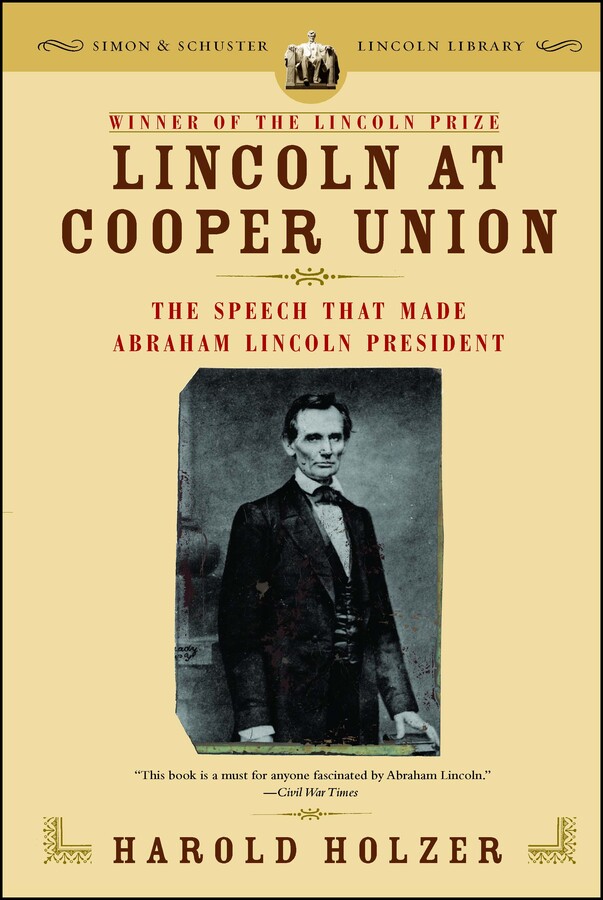
Lincoln at Cooper Union
The Speech That Made Abraham Lincoln President  
This edition: Trade Paperback, 368 pages
Availability: Usually ships within 1 business day
List Price: $15.00
Your Price: $12.00 You Save $3.00 (20%)
Also available in

Read an excerpt:

Introduction

Introduction

Among the many tantalizing "what ifs" of the Civil War era -- what if Stonewall Jackson had survived past 1863; what if George G. Meade had pursued the shattered Confederate army after Gettysburg; what if Abraham Lincoln had eluded assassination -- is one question that must precede all the others. What if Lincoln the aspiring presidential candidate had failed his first, grueling, decisive test of political and oratorical skills in New York City?

In fact, it is entirely possible that had he not triumphed before the sophisticated and demanding audience he faced at New York's Cooper Union on February 27, 1860, Lincoln would never have been nominated, much less elected, to the presidency that November. And had Lincoln not won the White House in 1860, the United States -- or the fractured country or countries it might otherwise have become without his determined leadership -- might today be entirely different.

This is the story of that momentous speech: its impetus, preparation, delivery, reception, publication, calculated reiteration, and its enormous, perhaps decisive, impact on that year's presidential campaign. It seeks to ask and answer the question from which historians have long shied: Why did this voluminous, legalistic, tightly argued, fact-filled address prove so thrilling to its listeners, so irresistible to contemporary journalists, and such a boost to Lincoln's political career? How exactly did it transform its author from a relatively obscure Illinois favorite son into a viable national contender for his party's presidential nomination?

To find the answers required deep investigation into original reports and recollections and the shunning of the many, but fleeting, mentions of the speech in modern biographies, which have shed little light on the Cooper Union enigma.

For all of its universally acknowledged importance, Lincoln's Cooper Union address has for years enjoyed a peculiar reputation. It is widely understood to have somehow propelled Lincoln to the presidency. Yet it has been virtually ignored by generations of historians, most of whom have relegated it to the status of exalted footnote. Cooper Union remains, vexingly, the best known of Abraham Lincoln's speeches that no one seems to quote or cite; the most important of his addresses whose importance no one can quite explain beyond simply reiterating its importance; and the most famous of his speeches that almost no one today ever reads.

Myth and misunderstanding have conspired further to obscure Lincoln's accomplishment as thickly as the dense fog that enshrouded New York City only a few weeks before his arrival. Generally, when it has been mentioned at all, the Cooper Union speech has been celebrated for the wrong reasons, while its true virtues have oddly been ignored.

One thing may be said with certainty. Had Lincoln failed at his nerve-wracking, physically exhausting, do-or-die New York debut, history would long ago have relegated his name to the trash heap of obscurity. In the words of a twentieth-century song, had he not made it here, he might not have made it anywhere. He would never have won his party's presidential nomination three months later, or the bitter election that followed six months after the convention. He would never have confronted the agonizing choice between war and peace -- to accept secession or fight to preserve the Union. And he would never have enjoyed the opportunity to strike a fatal blow against slavery, or to refashion American democracy into the global example he believed to be its rightful destiny. He would, to twist his own, later words, have "escaped history" altogether.

As far as his subsequently earned, exalted place in political literature -- which Walt Whitman, Harriet Beecher Stowe, and Edmund Wilson, among others, have celebrated -- it is probably fair to say that without Cooper Union first, there would have been no Gettysburg Address, no Second Inaugural, no further grand opportunities.

Then why is Cooper Union so little known today?

Perhaps its intimidating length -- it is ten times longer than the Second Inaugural address, and some twenty-eight times the size of his masterpiece at Gettysburg -- has discouraged recollection and analysis. So, possibly, has the fact that, stylistically, it is so completely unlike anything that Lincoln produced either before or after his New York appearance. On the one hand, it is infinitely more restrained, intricate, and statesmanlike than the stem-winding oratory with which Lincoln earned his reputation as a public speaker in the West. Yet it is also far less elegiac than the monumental speeches that he delivered once he was elected to the presidency and the Civil War began. In the Lincoln canon, it represents an altogether unique rhetorical watershed, the transforming moment separating the prairie stump speaker and the presidential orator.

To further complicate matters, careful study reveals the complex Cooper Union address itself to be, in a sense, three distinct speeches in one, each ingeniously calculated to validate the antislavery platform of Lincoln's Republican party through completely different approaches: legal precedent, a hearty dose of ironic challenge, and a dazzling coda of inspiring political faith. For this reason, too, Cooper Union has resisted easy analysis. Remarkably, the speech has until now inspired only one brief book, now forty years old.

Modern readers consulting the few existing sources on the subject might reasonably conclude that Lincoln was simply invited to New York City, sat down and wrote out a fine speech, then went on to deliver it successfully. They might think that he did so unaware of political challenges confronting him at home and across the country from Democrats and fellow Republicans alike. They might suspect that Lincoln was ambivalent or indifferent about the presidency, and unschooled in the vast historical literature he was called upon to digest, explain, and rebut in New York. They would likely fail to take into account the frenzied, partisan press that Lincoln knew would simultaneously praise and pillory his performance, and to which he tailored his address as surely as he crafted it for his "hearing" audience. The truth is, the full history of Lincoln's Cooper Union experience -- its origins and its aftermath -- is far richer, the context of Lincoln's New York debut more nuanced, and the challenge he faced far more daunting than earlier books have acknowledged.

Yes, the Gettysburg Address, Lincoln boasted, was "short, short, short," while the Cooper Union address is long, long, long. But Cooper Union has long cried out for study.

To properly appreciate its impact in its time and place, however, requires a significant leap of imagination. It may be hard for modern Americans accustomed to today's political sound bites and carefully timed question-and-answer-style presidential debates -- which we view in the comfort of home on television -- to appreciate the frenzied, all-consuming, society-defining political culture of the Lincoln era. But understanding that culture is crucial to understanding the Cooper Union address.

Lincoln's zealous contemporaries virtually lived and breathed politics -- a passion manifested by the 80% voter turnout in the 1860 election. And they hungrily feasted on public oratory, flocking to hear candidates hold forth for hours at a time on the issues of the day.

In Lincoln's time, political speechmaking provoked the devotion of old-time religious revivalism and unleashed a level of community passion unequalled until the introduction of professional sports generations later. Citizens followed politics avidly, decorated their homes with pictures of their leaders, and took their families to political events as eagerly as they might visit church or the annual county fair.

Speeches and speakers might engulf entire towns, villages, and cities in waves of excitement. Crowds practically fought "a hand-to-hand conflict for even the meagerest...standing room" to hear politicians hold forth, as one journalist of the day observed with astonishment. Speeches and debates might inspire raucous parades, banner-waving, picnicking, drinking, brawling, and demonstrations bursting with fireworks, music, torchlights, and still more speeches. Hard as it is to conceive, during the Lincoln-Douglas debates of 1858, one audience, though exhausted after hearing three long hours of political argumentation under a scorching midsummer sun, happily headed off afterward to hear yet another speech, as if it could simply not get its fill of such oratory.

Into this long-vanished political culture Lincoln emerged and thrived, developing into a shrewd crowd pleaser who even his lifelong political rival Stephen A. Douglas acknowledged to be "full of wit, facts, dates -- the best stump speaker, with his droll ways and dry jokes, in the West." Over time, Lincoln became wise not only in the ways of enthralling crowds, but in creating prose that could also be usefully reprinted in party-affiliated newspapers. For long before the introduction of newsreels, radio, and television, newspapers afforded information-hungry party loyalists scattered in rural isolation throughout the country their chief access to politicians and their unexpurgated ideas. Lincoln would want his Cooper Union speech to resound in print as effectively as it did in person, helping to magnify its impact and increase its influence.

The Cooper Union address tested whether Lincoln's appeal could extend from the podium to the page, and from the rollicking campaigns of the rural West to the urban East, where theaters, lecture halls, and museums vied with politics for public attention. Cooper Union held the promise of transforming Lincoln from a regional phenomenon to a national figure. Lincoln knew it, and rose to the occasion.

As if to illustrate his metamorphosis, the Cooper Union appearance also inspired the most important single visual record of Lincoln's, or perhaps any, American presidential campaign: an image-transfiguring Mathew Brady photograph. Its later proliferation and reproduction in prints, medallions, broadsides, and banners perhaps did as much to create a "new" Abraham Lincoln as did the Cooper Union address itself.

Supposedly, Lincoln volunteered when he encountered the famous photographer again a few months later: "Brady and the Cooper Institute made me President." There is no corroborating contemporary evidence that Lincoln ever said anything of the kind. But he might as well have. Make him president, they undoubtedly did. This book attempts to explain how that happened.


A note is offered to explain how Lincoln's speech is referred to in this book, and also how the text identifies Peter Cooper's academy, which still sits at Astor Place in Manhattan and continues to function as a free college for gifted students in the fields of engineering, architecture, and design.

Officially the school was -- and remains -- Cooper Union. But from the time its Great Hall began presenting speakers in 1859, a few months before the school even opened its doors to students, a so-called "People's Institute" established itself to organize public programs there for the further enlightenment of both its enrollees and the general public.

Thereafter, Lincoln and nearly all of his contemporaries, including journalists, began referring to the school itself as "Cooper Institute" or "Cooper's Institute." To most Americans of Lincoln's day, his 1860 speech thus became known as the "Cooper Institute" address. Readers will see on the pages that follow many references to the "Institute," not the "Union," from both Lincoln and his contemporaries.

Abraham Lincoln, however, lectured not for the "Institute" group, but for an independent political organization that rented the building's Great Hall for the evening. Therefore it is proper to say that he spoke at Cooper Union, not Cooper Institute. Besides, Cooper Union is the name by which the school ultimately came to be known, just as originally planned.

For the sake of accuracy and uniformity alike -- with apologies for the resulting, unavoidable inconsistency -- the narrative of this book employs "Cooper Union" throughout.

Copyright © 2004 by Harold Holzer