
Plus, receive recommendations and exclusive offers on all of your favorite books and authors from Simon & Schuster.
Table of Contents
About The Book
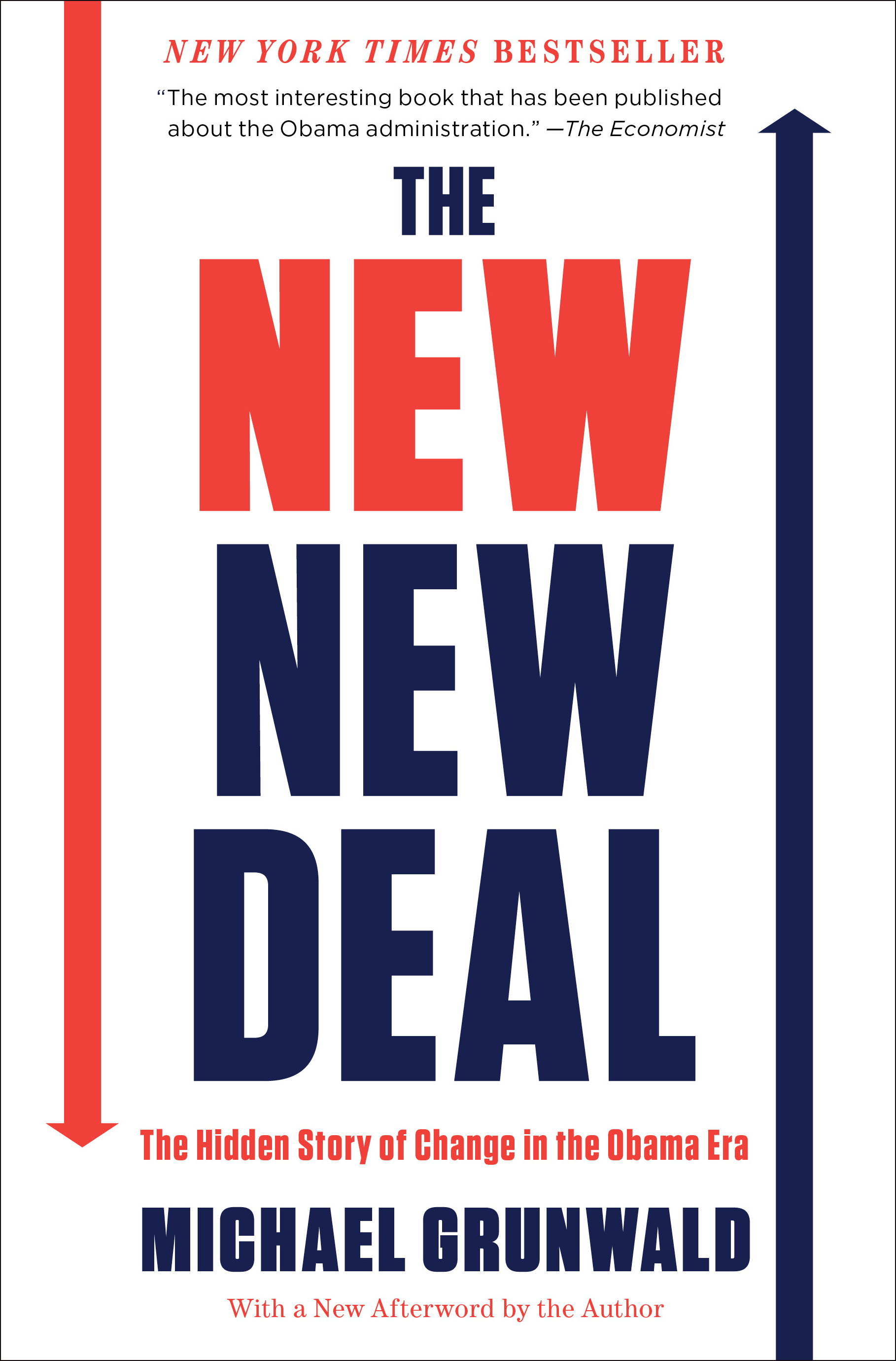
A New York Times bestseller, now with a new foreword by the author, The New New Deal is a riveting story about change in the Obama era—an essential handbook for citizens who want the truth about the president, his record, and his enemies.
Drawing on new documents and interviews with more than 400 sources, award-winning reporter Michael Grunwald reveals the vivid story behind one of the most important and least understood laws in U.S. history, President Obama’s $800 billion stimulus. Grunwald’s New York Times bestseller shows how the politically disastrous stimulus was a real new New Deal, preventing a depression while jumpstarting the president’s ambitious agenda for lasting change. It launched America’s transition to a clean-energy economy, established the boldest education reform in U.S. history, overhauled the nation’s antipoverty programs, and funded the most extensive infrastructure investments since Eisenhower’s interstate highway system. This is the definitive account not only of a transformative law, but of a transformative president’s first term.
Drawing on new documents and interviews with more than 400 sources, award-winning reporter Michael Grunwald reveals the vivid story behind one of the most important and least understood laws in U.S. history, President Obama’s $800 billion stimulus. Grunwald’s New York Times bestseller shows how the politically disastrous stimulus was a real new New Deal, preventing a depression while jumpstarting the president’s ambitious agenda for lasting change. It launched America’s transition to a clean-energy economy, established the boldest education reform in U.S. history, overhauled the nation’s antipoverty programs, and funded the most extensive infrastructure investments since Eisenhower’s interstate highway system. This is the definitive account not only of a transformative law, but of a transformative president’s first term.
Excerpt
The New New Deal — INTRODUCTION — Things That Never Were
Change begins with a leap of faith—not a fairy-tale faith that tomorrow will always turn out better than today, or a rah-rah faith in the inevitable destiny of God’s most favored nation, but a more practical belief that the past is not necessarily prologue, that the future doesn’t have to look like the present. It’s progressive in the literal sense, not the polite-way-to-say-liberal sense, a simple faith in the possibility of progress. This basic notion that there’s nothing preordained about the status quo can sound corny, and it doesn’t make change happen. But it makes change possible.
This is what Barack Hussein Obama meant by “the audacity of hope.” And this was the wind behind his 2008 campaign, the promise of not just the change we always hear about but Change We Can Believe In, the idea that a skinny black guy with an inconvenient name and a thin résumé could ride a dream to the White House. It was easy to mock his Yes We Can hubris, his grandiose vows to transcend the pettiness of our politics and bridge the partisan divide, his messianic pledges to slow the rise of the oceans and usher in a new birth of freedom. But he inspired people. After eight exhausting years of George W. Bush—the partisan warfare, the nonexistent weapons of mass destruction, the surpluses alchemized into record deficits, the inept response to a drowned city, and finally the epic financial and economic collapse—millions of Americans were ready for a leap of faith.
What happened to that change—and that faith—is the central story of the Obama administration.
The prevailing narrative has emphasized the unfulfilled promise, the change we’re still waiting for, the gap between the lofty poetry of Yes We Can and the transactional tawdriness of If We Can Round Up The Votes. The partisan divide remained un-bridged, the pettiness of our politics un-transcended. And the economy stubbornly refused to comply with Obama’s rhetoric of revival, setting the tone for a narrative of disappointment: Wasn’t the audacity of hope supposed to make people feel better? Hadn’t he promised to “reinvent the economy to seize the future”? What happened to the strong middle class and the new American century and all those other nice things that were supposed to materialize after his historic election? “Hope and change” became a partisan punch line, the wink behind Sarah Palin’s sly taunt: “How’s that hopey-changey stuff working out for ya?”
In the 2010 congressional elections, Americans gave a preliminary answer, voting to change the change, smacking down Democrats, rewarding Republicans for resisting the Obama agenda. Even the president toned down the hopey-changey stuff as his approval ratings slumped, reminding supporters that he was elected to make things better over time, not to make things perfect overnight.
“We’ve always known that lasting change wouldn’t come quickly or easily,” he wrote in the strangely muted email announcing his reelection campaign. “It never does.”
That’s part of the story: Change is hard.
But there’s more to the story: Change is happening.
It isn’t happening because a politician waved a magic wand. It’s happening the way change happens in American democracy, through legislation that Congress passes and a president signs and bureaucrats implement.
This is the story of Obama’s most ambitious and least understood piece of legislation, the purest distillation of what he meant by change. It aimed to repair a broken economy while reforming our approach to energy, health care, education, taxation, transportation, and more. It’s starting to change our cars and our trains, the way we produce and consume electricity, the way our schools teach, our doctors practice, and our government spends our money.
It’s even trying to change photosynthesis, which is as good a place as any to begin the story.
Sure, photosynthesis has been working reasonably well for 3.5 billion years, making plants grow, releasing the oxygen that sustains life on earth. But at the dawn of the Obama administration, it wasn’t working well enough for the president’s hard-charging energy secretary, Steven Chu, a quantum physicist who had won a Nobel Prize for trapping and cooling atoms with lasers. Chu had the toothy grin, dorky glasses, and wispy build of a tech nerd, but he had a steely side, too. He didn’t accept that problems were unsolvable unless there was scientific proof.
Chu was at the vanguard of a new brigade of egghead elites—a new, ultra-confident Best and Brightest—who marched into Obama’s Washington because they believed all that hopey-changey stuff. At sixty, he was a renewable energy source in his own right, exuding the boyish enthusiasm of a junior high geek dissecting his first frog. He worked eighty hours a week trying to rev up the sluggish Department of Energy, then spent his spare time doing the kinds of things geniuses do, like trying to cure cancer with nanotechnology, and using an atom interferometer to confirm a key prediction of Albert Einstein’s theory of relativity. His mere presence at this perennial backwater of a bureaucracy felt surreal, as if Einstein had reported for duty as labor secretary. Most of his predecessors had been obscure politicians or businessmen, and one had been a dentist. But after three decades playing with gamma rays and quarks at Bell Labs, Stanford, and Berkeley, Chu honestly believed he could help Obama cure America’s addiction to oil and help save the planet from global warming. He was a tone-deaf politician, but he quickly became Obama’s most compelling green evangelist, preaching the gospel of clean energy, sharing the good news of solar power, geothermal heat pumps, and energy-saving white roofs.
He wanted biofuels in his scripture, too. Fuels derived from biomass had been hyped as the great green hope, the renewable key to a world without oil. As a farm state senator, Obama had always portrayed ethanol and other biofuels as miracle elixirs. But Chu suspected they would never outcompete fossil fuels as long as they relied on photosynthesis. It was a chemistry thing. Harvesting sunlight to grow corn or switchgrass or even algae was just an awfully circuitous strategy for producing fuel, like a journey from New York to Washington via San Francisco. More than 99 percent of the solar energy was wasted along the route. “Photosynthesis,” Chu liked to complain, “is too damn inefficient.”
Fortunately, a new agency called ARPA-E had just been created inside Chu’s department to solve problems like photosynthesis.
The Advanced Research Projects Agency-Energy was a government incubator for high-risk, high-reward, save-the-world private energy research, the kind of place where Q from the James Bond movies would want to work. Modeled after DARPA, the legendary Pentagon agency that fathered the Internet and GPS technology, it was designed to finance out-of-the-box, early-stage experiments that probably wouldn’t pan out, but just might point the way toward truly clean coal or a truly smart grid or a truly green economy if they did. Chu was ARPA-E’s intellectual godfather; he had proposed the agency while serving on a National Academy of Sciences panel on U.S. competitiveness. He had handpicked its first director, his former Berkeley colleague Arunava Majumdar. And he had set its reach-for-the-stars tone, making it clear that ARPA-E wasn’t about incremental improvements. The agency’s mantra was: Game-changers only.
ARPA-E felt more like a high-tech start-up than a federal bureaucracy, with a foyer cluttered with intimidating textbooks on “tribology,” “constructal theory,” and “nanostructure physics,” and walls dotted with dreamy Yes We Can messages from Martin Luther King Jr. (“We are confronted with the fierce urgency of now”), John F. Kennedy (“We need men who can dream of things that never were”), and Chu himself (“Resist the urge to accept the status quo”). It was exempt from the usual civil service rules, and it attracted an absurdly high-powered staff of brainiacs: a thermodynamics expert from Intel who had published sixty-five scientific papers, an MIT electrical engineering professor who had founded two start-ups, a clean-tech venture capitalist who also taught material science at MIT. Majumdar, a world-renowned energy expert, had run Berkeley’s nanotechnology institute before Chu persuaded him to leave his tenured chair—as well as his wife, two children, and a yellow Lab—behind in California to make change in Washington. His deputy, Duke biochemistry professor Eric Toone, was also a biotech entrepreneur who had helped develop a promising glaucoma drug.
None of these men—they were all men—were in public service because they needed a job. They were the kind of dreamers President Kennedy had in mind, imagining things that never were: wind turbines shaped like jet engines, man-made substitutes for rare-earth minerals, electrical transformers the size of suitcases instead of kitchens. They saw energy as the challenge of their era, and ARPA-E as their moon mission. They were practical men who understood that even elegant laboratory advances in batteries or biofuels had to be scalable and affordable to be useful, but they were also true believers in the church of progress, confident they would reach those moons in due time.
“We chemists would say energy is a kinetic problem, not a thermodynamic problem,” Toone says. “There’s always a way around kinetic problems.”
Toone had never studied biofuels, but he took on the photosynthesis problem. It was a real problem; just about all our energy was ultimately derived from photosynthesis, including the hydrocarbons in gasoline and other fossil fuels, even including the carbohydrates we break down when we pedal our bikes. But Toone had an epiphany after consulting with two groups of scientists who shared his inexperience in the energy field: the synthetic biology community, which manipulates cells and molecules, and the “extremophile” community, which studies microscopic organisms in exotic eco-niches like hot springs and ocean floors. Some of those organisms had evolved to absorb energy without photosynthesis, subsisting on hydrogen, ammonia, or even electric current. But none had been studied for fuel production. Toone realized that with the proper tinkering and the proper funding, it might be possible to train the kind of bacteria that eat electricity for breakfast to fuel our transportation sector someday. In October 2009, he hosted the first ever workshop on the topic, bringing together big brains from far-flung fields and encouraging them to imagine the possibilities.
“It was amazing how fast everyone went from ‘This is nuts!’ to ‘Hmmm,’?” he recalls.
Soon Toone presented his findings to the ARPA-E team. Majumdar had a knack for gouging holes in talks like this, pulverizing tenured hotshots into stammering grad students. This time he just sat in silence.
“Holy shit,” he finally said in the lilt of his native Calcutta. “We’re talking about an entirely new scientific discipline.”
At a brainstorming session at ARPA-E’s unofficial watering hole, a D.C. dive bar called the Ugly Mug, Toone came up with the new discipline’s name: electrofuels. Within a few months, ARPA-E received 120 electrofuels proposals from scientists in all kinds of fields. And in April 2010, at a cabinet meeting led by Vice President Joe Biden, Chu unveiled thirteen electrofuels grants. A Boston firm planned to engineer E. coli into “a chassis for iso-octane.” A University of South Carolina team would study “electroalcoholgenesis-bioelectrochemical reduction of CO2.” Biden’s staff had invited me to sit in during the meeting—I’m a journalist for Time magazine—and as Chu explained a Harvard Medical School team’s plan to create a “bacterial reverse fuel cell,” I could almost see a “WTF?” thought bubble forming over the vice president’s head.
Then Chu started talking a language everyone could understand; as a kid on Long Island, before his own circuitous journey from New York to Washington via San Francisco, he had been a baseball statistics nerd. “We’re swinging for the fences,” Chu said. “We’re going to strike out a lot, but we’ll hit a few grand slams.” Most of ARPA-E’s experiments would fail, but one successful project could kill off the internal combustion engine, or slash the cost of air-conditioning in half. Someday, electrofuels could be ten times as efficient as biofuels.
“Wow!” Biden crowed. “We’re talking about research that will literally revolutionize American life!” (Biden often says “literally,” or “literally, and I mean literally, not figuratively!” when he means “figuratively.”) He then veered into a soliloquy about American ingenuity, then a shaggy-dog story about an energy-efficient lighting firm, then on to other business. But afterward, Biden was still jazzed. “Was that mind-blowing or what?” he asked, throwing his arm over my shoulder as if we were lifelong pals, when we had just been introduced moments earlier. “This is the exciting part of my job: We’re building tomorrow!” We chatted for a minute about ARPA-E, and how it was a pretty striking example of the change Obama had promised during his campaign.
“That’s what nobody gets about the Recovery Act,” Biden said.
Yes, ARPA-E was launched by the American Recovery and Reinvestment Act, President Obama’s widely ridiculed $787 billion “stimulus” package. The audacity of hope made change possible. The Recovery Act is making change happen.
President Obama signed the stimulus into law on February 17, 2009, less than a month after his inauguration, just a few months after the meltdown of the global financial system. The U.S. economy was in freefall, and Americans were desperate for change. Obama’s approval ratings were around 70 percent, Democrats had expanded their majorities in Congress, and talking heads were suggesting the Republican Party might be lurching toward extinction. Meanwhile, the rest of the world’s major powers were also preparing stimulus packages to defibrillate their flat-lining economies.
Yet Obama’s 1,073-page response to the worst crisis since the Great Depression swiftly became a national laughingstock—and the launching pad for the Republican revival. It was the Ur-text of the Obama administration, a microcosm of policy and politics in the Obama era. “No question about it, the stimulus was the defining moment,” says former Republican senator Mel Martinez of Florida. “The Recovery Act set the tone,” agrees David Axelrod, Obama’s top political adviser.
Within a year, the percentage of Americans who believed the stimulus had created any jobs was lower than the percentage of Americans who believed that Elvis was alive. Resurgent Republicans mocked the law as “Porkulus,” a bloated encapsulation of everything wrong with the Obama presidency. “Failed-stimulus” became a fourteen-letter GOP buzzword of choice, repeated incessantly in floor speeches, press conferences, and attack ads. Senate minority leader Mitch McConnell snarked that even Tiger Woods and John Edwards, the sex scandal stars of 2009, had better years than the failed-stimulus. A drumbeat of gotcha stories chronicled silly expenditures, like costumes for water safety mascots; silly-sounding legitimate expenditures, like a brain chemistry study of cocaine-addicted monkeys; and fictitious expenditures, like levitating trains to Disneyland or a snow-making machine in Duluth. Even Jay Leno got in a dig about communism, “or, as we call it in this country, a stimulus package.”
The mockery got so intense that Democrats stopped saying “stimulus” in public. And their sidestepping got so blatant that a reporter confronted Obama about it at a news conference, asking why his aides “avoid the word ‘stimulus’ like the plague. Is that because the original stimulus is so deeply unpopular?”
The president wouldn’t even use the word “stimulus” in his response.
The stimulus had one overriding public relations problem: The administration marketed it as a measure to prevent rampant unemployment—and then rampant unemployment happened anyway. Americans understood that Obama inherited a mess, but they didn’t understand how horrible a mess, and the stimulus was touted as a job creator at a time when jobs were disappearing at record speed. A politically disastrous January 2009 report by Obama’s economics team intensified this problem by warning that the jobless rate could hit 9 percent without the Recovery Act, while predicting it would stay below 8 percent with the Recovery Act, a gaffe that launched a thousand talking points after unemployment reached 10 percent despite the Recovery Act. These were understandable forecasting errors, based on consensus assumptions; it soon became clear that the pre-stimulus situation was much worse and disintegrating much faster than most economists realized at the time. But Republicans recognized the report as a gift that would keep on giving, and have savaged the stimulus ever since as a massive boondoggle charged to our maxed-out national credit card. Meanwhile, the left has griped that it wasn’t massive enough. And the media have repeatedly dismissed it as a failure “by the administration’s own standards.”
The Recovery Act certainly wasn’t perfect. It was the product of an imperfect legislative process, authored and implemented by imperfect human beings. It was oversold as a short-term economic fix, undersold as a long-term catalyst for change, and fumbled as a political football. It didn’t create full employment. And its critics inflated the failure of a stimulus-funded solar manufacturer called Solyndra into a classic Washington pseudo-scandal.
I worked for nine years in Washington as a national reporter for The Washington Post, mostly writing critical stories about dysfunctional government agencies. I was familiar with the city’s groupthink, the way its media narratives can harden into conventional wisdom. But I didn’t live in Washington anymore, so I didn’t swim in circles where suggesting that the stimulus was anything but a joke was a sign of credulity and cluelessness. And I still wrote about domestic policy, so I knew that the Recovery Act was more than the honeybee insurance, contraception subsidies, and other porky-sounding line items that got so much airtime on TV. It seemed like a big deal—actually, a collection of big deals. I didn’t know if it was a good deal, but it reminded me of the New Deal, a mammoth government effort aimed at short-term Recovery and long-term Reinvestment.
I spent two years researching the stimulus, and I found that it is a new New Deal. Much of the Recovery Act’s impact has been less obvious than the original New Deal’s, but it’s just as real.
“Bigger!”
Nostalgic liberals complain that the Recovery Act pales in comparison to the New Deal. It didn’t create giant armies of new government workers in alphabet agencies like the WPA, CCC, and TVA; ARPA-E is its only new federal agency, with a staff smaller than a Major League Baseball roster. It didn’t establish new entitlements like Social Security and deposit insurance, or new federal responsibilities like securities regulation and labor relations. It didn’t set up workfare programs for the creative class like the Federal Theatre Project, Federal Music Project, or Federal Art Project. (Obama aides grumble that it could have used a new Federal Writers Project to churn out better pro-stimulus propaganda.) And it didn’t raise taxes; it reduced taxes for the vast majority of American workers, although few of them noticed.
Obama and his aides thought a lot about the New Deal while assembling the Recovery Act, but in some ways it’s an apples-to-bicycle comparison. While President Franklin D. Roosevelt forged the New Deal through a barrage of sometimes contradictory initiatives enacted and adjusted over several years, the stimulus was a single piece of legislation cobbled together and squeezed through Congress before most of Obama’s appointees were even nominated. The New Deal was a journey, an era, an aura. The Recovery Act was just a bill on Capitol Hill.
But it was an astonishingly big bill. In constant dollars, it was more than 50 percent bigger than the entire New Deal, twice as big as the Louisiana Purchase and Marshall Plan combined. As multibillion-dollar line items were being erased and inserted with casual keystrokes, Obama aides who had served under President Bill Clinton occasionally paused to recall their futile push for a mere $19 billion stimulus that had seemed impossibly huge in 1993, or their vicious internal battles over a few million bucks for beloved programs that suddenly seemed too trivial to discuss. And the Recovery Act’s initial estimate of $787 billion turned out to be too low; the official price tag would eventually climb to $831 billion. After a live microphone caught Biden accurately calling Obama’s health reforms “a big fucking deal,” I suggested to his chief of staff, Ron Klain, that the stimulus was just as big.
“Bigger!” Klain replied.
Biden’s boast about the Recovery Act building tomorrow was accurate, too. It was the biggest and most transformative energy bill in U.S. history, financing unprecedented government investments in a smarter grid; cleaner coal; energy efficiency in every imaginable form; “green-collar” job training; electric vehicles and the infrastructure to support them; advanced biofuels and the refineries to brew them; renewable power from the sun, the wind, and the heat below the earth; and factories to manufacture all that green stuff in the United States.
That’s a lot of new precedents.
The stimulus was also the biggest and most transformative education reform bill since the Great Society. It was a big and transformative health care bill, too, laying the foundation for Obama’s even bigger and more transformative reforms a year later. It included America’s biggest foray into industrial policy since FDR, biggest expansion of antipoverty initiatives since Lyndon Johnson, biggest middle-class tax cut since Ronald Reagan, and biggest infusion of research money ever. It authorized a high-speed passenger rail network, the biggest new transportation initiative since the interstate highways, and extended our existing high-speed Internet network to underserved communities, a modern twist on the New Deal’s rural electrification. It updated the New Deal–era unemployment insurance system and launched new approaches to preventing homelessness, financing infrastructure projects, and managing stormwater in eco-friendly ways. And it’s blasting the money into the economy with unprecedented transparency and oversight.
“We probably did more in that one bill than the Clinton administration did in eight years,” says one adviser to Clinton and Obama.
Critics often argue that while the New Deal left behind iconic monuments—the Hoover Dam, Skyline Drive, Fort Knox—the stimulus will leave a mundane legacy of sewage plants, repaved potholes, and state employees who would have been laid off without it. Even the Recovery Act’s architects feared that like Winston Churchill’s pudding, it lacked a theme. In reality, it’s creating its own icons: zero-energy border stations, state-of-the-art battery factories, an eco-friendly Coast Guard headquarters on a Washington hillside, a one-of-a-kind “advanced synchrotron light source” in a New York lab. It’s also restoring old icons: the Brooklyn Bridge and the Bay Bridge, the imperiled Everglades and the dammed-up Elwha River, Seattle’s Pike Place Market and the Staten Island ferry terminal. But its main legacy, like the New Deal’s, will be change.
That is also its main theme.
No, it’s not the New Deal. Obama is not a classic New Deal liberal, and while he shares some of Roosevelt’s traits—self-assurance bordering on egomania, a Harvard pedigree, an even keel, an allergy to ideologues—he’s not the second coming of FDR. He didn’t grow up rich and he didn’t battle polio. He doesn’t welcome the hatred of the elite and he hasn’t forged a unique bond with the masses. He doesn’t share Roosevelt’s mistrust of credentialed experts, and he takes his campaign promises much more seriously than FDR did.
But the Recovery Act did update the New Deal for a new era. It was Obama’s one shot to spend boatloads of money pursuing his vision, a major down payment on his agenda of curbing fossil fuel dependence and carbon emissions, modernizing health care and education, making the tax code more progressive and government more effective, and building a sustainable, competitive twenty-first-century economy. It’s what he meant by “reinvent the economy to seize the future.”
For starters, the stimulus did provide stimulus.
The Recovery Act injected an emergency shot of fiscal adrenaline into an economy that was hemorrhaging over 700,000 jobs a month. The leading independent economic forecasters—firms like Macroeconomic Advisers, Moody’s Economy.com, IHS Global Insight, J.P. Morgan Chase, and Goldman Sachs, as well as the nonpartisan Congressional Budget Office—all agree that the stimulus helped stop the bleeding, averting a second depression and ending a brutal recession. The Recovery Act wasn’t the only government intervention that helped stabilize the patient. The Federal Reserve’s emergency support for the financial sector, Obama’s unpopular rescue of the auto industry, and the even less popular Wall Street bailout that began under Bush all helped keep the economy afloat. But on the job loss graphs from the Great Recession, the low point came right before stimulus dollars started flowing. Then the situation slowly began to improve.
The Recovery Act followed the crisis response manual of the late British economist John Maynard Keynes, the godfather of fiscal stimulus. Keynes urged policymakers—including Roosevelt, who didn’t listen too carefully—to “prime the pump” during downturns, to pour gobs of public money into their economies when private money was in hiding. The idea was to halt the classic death spiral where businesses facing weak demand lay off workers, which further weakens demand as laid-off workers stop spending, which leads to further layoffs and weaker demand. That’s the nightmare Obama inherited after his inaugural parade. Credit was frozen, consumer confidence the lowest ever recorded. The economy was shrinking at an unheard-of 8.9 percent rate, although no one knew the numbers were that horrific at the time.
“It was obvious that the economy was going to hell,” recalls Berkeley economist Christina Romer, the first chair of Obama’s Council of Economic Advisers and coauthor of the infamous 8 percent unemployment report. “The question was the degree to which the economy was going to hell.” Obama’s team seriously underestimated that degree.
Nevertheless, the Recovery Act airlifted record amounts of Keynesian stimulus out of the Treasury to resuscitate demand: tax breaks for businesses and families to get cash circulating again; bailouts of every state to avert layoffs of teachers, police officers, and other public employees; one-time handouts to seniors, veterans, and the disabled; generous expansions of unemployment benefits, food stamps, health insurance, and other assistance for struggling families. The stimulus also put people to work directly with over 100,000 projects to upgrade roads, bridges, subways, water pipes, sewer plants, bus stations, fire stations, the Joseph R. Biden Jr. Railroad Station in Wilmington, Delaware, federal buildings, Grand Canyon National Park, trails, libraries, courthouses, the “national stream gauge network,” hospitals, Ellis Island, seaports, airports, dams, locks, levees, Indian reservations, fish hatcheries, coral reefs, passport offices, military bases, veterans cemeteries, historically black colleges, particle accelerators, and much more.
Today, those independent analysts believe the Recovery Act came close to achieving its goal of saving or creating at least 3 million jobs in the short term. The concept of “saving or creating” has inspired a lot of sarcasm—Obama joked after his annual Thanksgiving pardon that he had just saved or created four turkeys—but it simply means that close to 3 million more people would have been unemployed without the Recovery Act.
Unfortunately, the housing and banking apocalypse that preceded it wiped out about eight million jobs, so it didn’t come close to filling the entire hole. Unemployment soared to double digits while it was still kicking into gear. State and local governments offset much of its impact with anti-Keynesian austerity, raising taxes, slashing spending, and sucking money back out of the economy. Still, the CBO and the private forecasters concluded that at its height, the Recovery Act increased output over 2 percent, the difference between growth and contraction. It also helped balance every state budget, sparing public jobs and public services from the chopping block; many Republican governors attacked it as out-of-control spending, but all of them took its cash. It made a painful time less painful, helping millions of victims of the Great Recession keep food on their tables and roofs over their heads. And the Chicken Littles who warned that a $787 billion fiscal stimulus would lead to runaway inflation or exorbitant interest rates were wrong. Inflation remained extremely low, interest rates historically low. The stimulus didn’t end America’s very real pain, but then again, the New Deal didn’t end the Depression. World War II ended the Depression.
Political critics have seized on that historical fact to try to discredit Obama’s stimulus, ignoring the more salient facts that Roosevelt’s commitment to stimulus was sporadic, the New Deal’s stimulus did reduce unemployment when it was in effect, and World War II was the mother of all stimulus programs. But facts have not driven the debate. Republicans have stuck to their failed-stimulus message with impressive discipline. They’ve argued that government simply can’t create jobs, often while attending ribbon cuttings for job-creating stimulus projects in their districts; that government shouldn’t help private companies, often while writing letters seeking stimulus funds for firms in their states; and that government can only create government jobs, even though all of America’s post-stimulus job growth has been in the private sector. They’ve argued that Keynes was wrong about stimulus, except when it comes to high-end tax cuts, military spending, and other stimulus they like. They’ve portrayed the Recovery Act as larded with earmarks, when it was the first modern spending bill with no earmarks, and riddled with fraud, when investigators have been amazed by the lack of fraud.
It’s been a brilliant strategy, and it planted the seeds for the Republican comeback.
“The stimulus was an Alamo moment for us, but we stuck together and made it out alive,” says Republican congressman Tom Cole of Oklahoma. “Now ‘stimulus’ is a dirty word.”
He’s right. A colossal package of tax breaks and spending goodies that were almost all popular individually has become toxic collectively, as if the proper response to the crisis would have been a stiff upper lip, as if Herbert Hoover had it right the first time. Obama has struggled to explain the counterintuitive Keynesian insight that government needs to loosen its belt when families and businesses are tightening theirs. He has also struggled to make the counterintuitive political case that things would have been even lousier without the Recovery Act. It’s true, but his slogan wasn’t Yes We Can Keep Things From Getting Even Lousier. He didn’t promise to create a somewhat-less-weak middle class. He always made it sound like the problems he inherited from Bush were kinetic problems, not thermodynamic problems.
As a kid rambling around Scranton, Pennsylvania, when Biden would break an arm or dislocate a hip, his mother would say: Joey, it could’ve been worse. You could’ve broken both legs. You could’ve crushed your skull. As the White House point man on the Recovery Act, Biden felt like he was recycling his mom’s talking points, trying to persuade America to feel grateful its injuries weren’t fatal. It’s hard to get credit for averting a catastrophe, because once catastrophe is averted, people focus more on the pain they’re feeling than the worse pain they might have felt in a hypothetical no-action case.
“One thing they never taught us in grad school was how to sell Keynesian stimulus,” says Biden’s former chief economist, Jared Bernstein, the other coauthor of the overoptimistic unemployment report. “?‘It Would’ve Been Even Worse Without Us’ is just a fruitless message.”
In any case, the ferocious debate over the short-term Recovery has obscured the long-term Reinvestment.
ARPA-E didn’t create any jobs in 2009, except for Majumdar’s and his team’s, and it didn’t create many after that. But the stimulus was only partly about stimulus. It was also about metamorphosis. ARPA-E amounted to just 0.05 percent of the Recovery Act—a new Manhattan Project in a rounding error—and most of its breakthroughs won’t produce results for years. But it’s emblematic of the law’s assault on the status quo. MIT professor Don Sadoway, a mad scientist in a bolo tie, has a radical vision of a liquid battery the size of a tractor-trailer that could store electricity for entire neighborhoods, so that renewable power could run our refrigerators when the sun isn’t shining and the wind isn’t blowing. He’s got a prototype the size of a shot glass; his $7 million ARPA-E grant is helping him scale up to the size of a hockey puck and then a pizza box. Sadoway snorted when I asked how many jobs his grant had created: “If this works, I’ll create a million jobs!”
Republicans have howled that many stimulus projects have little to do with short-term stimulus—and they’re right. There was nothing “shovel-ready” about bullet trains designed to connect Los Angeles to San Francisco in under three hours, broadband cables designed to bring rural towns into the wired world, electronic health records designed to drag medical bureaucracy out of the leeches era, smart dishwashers designed to run when electricity is cheapest, automated factories that will manufacture electric trucks in Indiana instead of China, the first U.S. testing facility for wind turbine blades as long as football fields, or research into a new generation of “space taxis” that might replace NASA’s shuttle someday. But these are the kind of long-term investments—more than one sixth of the stimulus—that Obama chief of staff Rahm Emanuel had in mind when he said “you never want a serious crisis to go to waste.” The Recovery Act is also financing the world’s largest wind farm in Oregon and the world’s most powerful X-ray laser in California. It’s funding the largest photovoltaic solar array, largest solar thermal plant, and largest effort to install solar panels on commercial rooftops.
None of those projects was shovel-ready, either, but they were all deemed shovel-worthy.
The Recovery Act’s most important long-term changes aimed to jump-start our shift to clean energy, reducing our carbon footprint, our electric bills, our vulnerability to oil shocks, and our subservience to petro-dictators while seeding green new industries. The stimulus converted Chu’s cobwebbed department into the world’s largest clean-tech investment fund. Overall, it pumped about $90 billion into green energy, when the United States previously spent a few billion a year.
The scale is almost unimaginable. Secretary Chu’s Office of Energy Efficiency and Renewable Energy, which had a $1.2 billion budget, got a $16.4 billion infusion. New Jersey’s state energy program received a 9,500 percent funding increase. The Recovery Act will also triple the smart meters in homes, quadruple the hybrids in the federal fleet, and expand electric vehicle charging stations forty-fold. It’s creating an advanced battery industry almost entirely from scratch, increasing the U.S. share of global capacity from 1 percent when Obama took office to about 40 percent in 2015. Yes, Solyndra failed, but thousands of other green stimulus investments haven’t.
The stimulus is also stocked with non-energy game-changers, like an initiative to sequence over 2,300 human genomes to help fight diseases like cancer and schizophrenia, when only thirty-four had been sequenced before. Or a $20 billion effort to computerize our pen-and-paper health system, which should reduce redundant tests, dangerous drug interactions, and fatal errors caused by doctors with chicken-scratch handwriting. Or the “Race to the Top” competition to promote data-driven reforms of public schools, which prompted dozens of states to revamp their education laws before they even submitted applications. Or the website recovery.gov, which lists every stimulus contract and lobbying contact, along with quarterly data detailing where all the money went.
At a time when government wasn’t supposed to be able to run a one-car funeral, the Recovery Act was a real-time test of a new administration’s ability to spend tax dollars quickly, honestly, and effectively—and to reshape the country in the process.
“America said it wanted change,” says Obama’s education secretary, Arne Duncan. “Well, this is it!”
The Opening Act of the Obama Era
The stimulus had its roots in Obama’s 2008 campaign agenda, which was mostly ignored while the media obsessed about his incendiary pastor, the ads comparing him to Paris Hilton, and other issues that had nothing to do with policy issues. It was put together during Obama’s chaotic presidential transition, while the press focused on who he would choose for his cabinet, which of his nominees hadn’t paid taxes, and what breed of dog he would give his daughters. It passed during his whirlwind first hundred days, when it competed for attention with his rescue plans for the auto, banking, and housing industries, his breaks with Bush on issues like torture, stem cells, and fuel efficiency, and controversies over everything from his handshake with Venezuelan strongman Hugo Chávez to the attempted sale of his Senate seat. Then its rollout was overshadowed by Obama’s epic battle over health care; his push to end the war in Iraq and expand the war in Afghanistan; the rise of the Tea Party, which held its first rally ten days after he signed the Recovery Act; the weak economy; the Republican revival; and the constant dramas over Somali pirates, Iranian nukes, Supreme Court nominations, financial regulations, beer summits, birth certificates, and killings of international terrorists that add up to an eventful presidency.
Ultimately, one of the most sweeping pieces of legislation in modern history was reduced to an afterthought. In April 2011, Obama’s most influential supporter asked him on national TV whether he wished he had started his presidency by focusing on the economy instead of health care. “Oprah, I’ve got to tell you, we did start with the economy,” Obama replied with evident irritation. “Remember, the first thing we did was pass a Recovery Act.” Polls have found that most Americans see the stimulus as a giveaway to bankers, confusing it with the $700 billion financial bailout that passed before Obama was elected. I interviewed several congressmen who were under the same misimpression.
This book aims to tell the story of the stimulus—how it happened, how it’s changing the country, how Republicans found their voice in opposing it, and how it’s been distorted by the Washington funhouse. There’s never been a bill this comprehensive hustled into law this fast, and its journey after passage has been equally unique.
The stimulus is also the ultimate window into the Obama era, the opening act that foreshadows the rest of the show—the just-say-no extremism of the right, the unquenchable ingratitude of the left, the backroom deals with centrist senators, the gotcha games of the media, and the president’s real achievements, as well as the limits of those achievements, and his struggles to market those achievements. Most of all, the battle over the Recovery Act made it clear that Obama’s dreams of post-partisanship were doomed from the start. It was full of tax cuts and government spending that traditionally enjoyed bipartisan support, but it was greeted with virtually unanimous opposition by congressional Republicans who had secretly decided to fight Obama on just about everything.
“If he was for it,” explains former Republican senator George Voinovich of Ohio, “we had to be against it.”
The stimulus was also a case study in Obamaism. To left-wingers, it exposed the president as a spineless sellout, more interested in cutting deals than chasing dreams, willing and possibly eager to throw his base under the bus, desperate to compromise with Republicans who would never compromise with him. To right-wingers, it revealed Obama as a big-spending radical imposing European socialism on American free enterprise, somehow thuggish (in his I-got-the-votes partisanship and Chicago-style deal making) and wimpy (in his deference to House speaker Nancy Pelosi and other leftist congressional overlords) at the same time.
In reality, the Recovery Act provided early evidence that Obama was pretty much what he said he was: a data-oriented, left-of-center technocrat who is above all a pragmatist, comfortable with compromise, solicitous of experts, disinclined to sacrifice the good in pursuit of the ideal. It reflected his belief in government as a driver of change, but also his desire for better rather than bigger government. And it was the first evidence that after campaigning as a change-the-system outsider he would govern as a work-the-system insider, that despite all his flowery talk he understood that bills that don’t pass Congress don’t produce change.
Obama never sent a formal stimulus bill to Congress, and there’s a broad perception that he punted the Recovery Act to Capitol Hill, another recurring theme in his presidency. But that’s another Beltway myth. Congress helped shape it, but it was unmistakably an Obama bill. And it has been implemented in an Obama way.
Inevitably, change in the Obama era will be judged in comparison to the candidate’s own rhetoric about renewing America’s promise and setting aside childish things, the New Age bombast that persuaded his grassroots army of Obamaniacs that they were the change they were waiting for. He did lay it on thick. The night he won the Iowa caucus with a mere 37.6 percent of the vote, he informed his supporters at the Des Moines Hy-Vee Hall that “years from now, you’ll look back and say that this was the moment—this was the place—where America remembered what it means to hope!” There was something begging-for-comeuppance about his pose as a politician above politics, denouncing the twenty-four-hour news cycle and the ten-second sound bite, crusading against Washington’s frivolity and negativity. Hadn’t this guy launched his career by challenging a state senator’s signatures and forcing her off the ballot? When exactly had America forgotten what it means to hope?
But even that heady night in Des Moines, Obama never suggested that he could snap his fingers and create a more perfect union. “Hope is not blind optimism,” he told the ecstatic crowd. “It’s not ignoring the enormity of the task ahead or the roadblocks that stand in our path. . . .” He was peddling hope, but he had been a community organizer for too long to expect change without struggle. The stimulus was a product of that audacious faith that the way things are is not necessarily the way things have to be, combined with the duller insight that things wouldn’t change without sixty votes in the Senate. Reasonable people can disagree about the Recovery Act, and there ought to be great debates about its implications for government intervention in various sectors of the economy. But first, people ought to hear the real story of what was in it, how it got there, and how it’s been translated into action.
This is a story about change, not just Obama. He’s not the guy who’s going to reinvent photosynthesis, and as he often tells crowds, change isn’t just about him.
But it begins with him. It’s his vision.
Change begins with a leap of faith—not a fairy-tale faith that tomorrow will always turn out better than today, or a rah-rah faith in the inevitable destiny of God’s most favored nation, but a more practical belief that the past is not necessarily prologue, that the future doesn’t have to look like the present. It’s progressive in the literal sense, not the polite-way-to-say-liberal sense, a simple faith in the possibility of progress. This basic notion that there’s nothing preordained about the status quo can sound corny, and it doesn’t make change happen. But it makes change possible.
This is what Barack Hussein Obama meant by “the audacity of hope.” And this was the wind behind his 2008 campaign, the promise of not just the change we always hear about but Change We Can Believe In, the idea that a skinny black guy with an inconvenient name and a thin résumé could ride a dream to the White House. It was easy to mock his Yes We Can hubris, his grandiose vows to transcend the pettiness of our politics and bridge the partisan divide, his messianic pledges to slow the rise of the oceans and usher in a new birth of freedom. But he inspired people. After eight exhausting years of George W. Bush—the partisan warfare, the nonexistent weapons of mass destruction, the surpluses alchemized into record deficits, the inept response to a drowned city, and finally the epic financial and economic collapse—millions of Americans were ready for a leap of faith.
What happened to that change—and that faith—is the central story of the Obama administration.
The prevailing narrative has emphasized the unfulfilled promise, the change we’re still waiting for, the gap between the lofty poetry of Yes We Can and the transactional tawdriness of If We Can Round Up The Votes. The partisan divide remained un-bridged, the pettiness of our politics un-transcended. And the economy stubbornly refused to comply with Obama’s rhetoric of revival, setting the tone for a narrative of disappointment: Wasn’t the audacity of hope supposed to make people feel better? Hadn’t he promised to “reinvent the economy to seize the future”? What happened to the strong middle class and the new American century and all those other nice things that were supposed to materialize after his historic election? “Hope and change” became a partisan punch line, the wink behind Sarah Palin’s sly taunt: “How’s that hopey-changey stuff working out for ya?”
In the 2010 congressional elections, Americans gave a preliminary answer, voting to change the change, smacking down Democrats, rewarding Republicans for resisting the Obama agenda. Even the president toned down the hopey-changey stuff as his approval ratings slumped, reminding supporters that he was elected to make things better over time, not to make things perfect overnight.
“We’ve always known that lasting change wouldn’t come quickly or easily,” he wrote in the strangely muted email announcing his reelection campaign. “It never does.”
That’s part of the story: Change is hard.
But there’s more to the story: Change is happening.
It isn’t happening because a politician waved a magic wand. It’s happening the way change happens in American democracy, through legislation that Congress passes and a president signs and bureaucrats implement.
This is the story of Obama’s most ambitious and least understood piece of legislation, the purest distillation of what he meant by change. It aimed to repair a broken economy while reforming our approach to energy, health care, education, taxation, transportation, and more. It’s starting to change our cars and our trains, the way we produce and consume electricity, the way our schools teach, our doctors practice, and our government spends our money.
It’s even trying to change photosynthesis, which is as good a place as any to begin the story.
Sure, photosynthesis has been working reasonably well for 3.5 billion years, making plants grow, releasing the oxygen that sustains life on earth. But at the dawn of the Obama administration, it wasn’t working well enough for the president’s hard-charging energy secretary, Steven Chu, a quantum physicist who had won a Nobel Prize for trapping and cooling atoms with lasers. Chu had the toothy grin, dorky glasses, and wispy build of a tech nerd, but he had a steely side, too. He didn’t accept that problems were unsolvable unless there was scientific proof.
Chu was at the vanguard of a new brigade of egghead elites—a new, ultra-confident Best and Brightest—who marched into Obama’s Washington because they believed all that hopey-changey stuff. At sixty, he was a renewable energy source in his own right, exuding the boyish enthusiasm of a junior high geek dissecting his first frog. He worked eighty hours a week trying to rev up the sluggish Department of Energy, then spent his spare time doing the kinds of things geniuses do, like trying to cure cancer with nanotechnology, and using an atom interferometer to confirm a key prediction of Albert Einstein’s theory of relativity. His mere presence at this perennial backwater of a bureaucracy felt surreal, as if Einstein had reported for duty as labor secretary. Most of his predecessors had been obscure politicians or businessmen, and one had been a dentist. But after three decades playing with gamma rays and quarks at Bell Labs, Stanford, and Berkeley, Chu honestly believed he could help Obama cure America’s addiction to oil and help save the planet from global warming. He was a tone-deaf politician, but he quickly became Obama’s most compelling green evangelist, preaching the gospel of clean energy, sharing the good news of solar power, geothermal heat pumps, and energy-saving white roofs.
He wanted biofuels in his scripture, too. Fuels derived from biomass had been hyped as the great green hope, the renewable key to a world without oil. As a farm state senator, Obama had always portrayed ethanol and other biofuels as miracle elixirs. But Chu suspected they would never outcompete fossil fuels as long as they relied on photosynthesis. It was a chemistry thing. Harvesting sunlight to grow corn or switchgrass or even algae was just an awfully circuitous strategy for producing fuel, like a journey from New York to Washington via San Francisco. More than 99 percent of the solar energy was wasted along the route. “Photosynthesis,” Chu liked to complain, “is too damn inefficient.”
Fortunately, a new agency called ARPA-E had just been created inside Chu’s department to solve problems like photosynthesis.
The Advanced Research Projects Agency-Energy was a government incubator for high-risk, high-reward, save-the-world private energy research, the kind of place where Q from the James Bond movies would want to work. Modeled after DARPA, the legendary Pentagon agency that fathered the Internet and GPS technology, it was designed to finance out-of-the-box, early-stage experiments that probably wouldn’t pan out, but just might point the way toward truly clean coal or a truly smart grid or a truly green economy if they did. Chu was ARPA-E’s intellectual godfather; he had proposed the agency while serving on a National Academy of Sciences panel on U.S. competitiveness. He had handpicked its first director, his former Berkeley colleague Arunava Majumdar. And he had set its reach-for-the-stars tone, making it clear that ARPA-E wasn’t about incremental improvements. The agency’s mantra was: Game-changers only.
ARPA-E felt more like a high-tech start-up than a federal bureaucracy, with a foyer cluttered with intimidating textbooks on “tribology,” “constructal theory,” and “nanostructure physics,” and walls dotted with dreamy Yes We Can messages from Martin Luther King Jr. (“We are confronted with the fierce urgency of now”), John F. Kennedy (“We need men who can dream of things that never were”), and Chu himself (“Resist the urge to accept the status quo”). It was exempt from the usual civil service rules, and it attracted an absurdly high-powered staff of brainiacs: a thermodynamics expert from Intel who had published sixty-five scientific papers, an MIT electrical engineering professor who had founded two start-ups, a clean-tech venture capitalist who also taught material science at MIT. Majumdar, a world-renowned energy expert, had run Berkeley’s nanotechnology institute before Chu persuaded him to leave his tenured chair—as well as his wife, two children, and a yellow Lab—behind in California to make change in Washington. His deputy, Duke biochemistry professor Eric Toone, was also a biotech entrepreneur who had helped develop a promising glaucoma drug.
None of these men—they were all men—were in public service because they needed a job. They were the kind of dreamers President Kennedy had in mind, imagining things that never were: wind turbines shaped like jet engines, man-made substitutes for rare-earth minerals, electrical transformers the size of suitcases instead of kitchens. They saw energy as the challenge of their era, and ARPA-E as their moon mission. They were practical men who understood that even elegant laboratory advances in batteries or biofuels had to be scalable and affordable to be useful, but they were also true believers in the church of progress, confident they would reach those moons in due time.
“We chemists would say energy is a kinetic problem, not a thermodynamic problem,” Toone says. “There’s always a way around kinetic problems.”
Toone had never studied biofuels, but he took on the photosynthesis problem. It was a real problem; just about all our energy was ultimately derived from photosynthesis, including the hydrocarbons in gasoline and other fossil fuels, even including the carbohydrates we break down when we pedal our bikes. But Toone had an epiphany after consulting with two groups of scientists who shared his inexperience in the energy field: the synthetic biology community, which manipulates cells and molecules, and the “extremophile” community, which studies microscopic organisms in exotic eco-niches like hot springs and ocean floors. Some of those organisms had evolved to absorb energy without photosynthesis, subsisting on hydrogen, ammonia, or even electric current. But none had been studied for fuel production. Toone realized that with the proper tinkering and the proper funding, it might be possible to train the kind of bacteria that eat electricity for breakfast to fuel our transportation sector someday. In October 2009, he hosted the first ever workshop on the topic, bringing together big brains from far-flung fields and encouraging them to imagine the possibilities.
“It was amazing how fast everyone went from ‘This is nuts!’ to ‘Hmmm,’?” he recalls.
Soon Toone presented his findings to the ARPA-E team. Majumdar had a knack for gouging holes in talks like this, pulverizing tenured hotshots into stammering grad students. This time he just sat in silence.
“Holy shit,” he finally said in the lilt of his native Calcutta. “We’re talking about an entirely new scientific discipline.”
At a brainstorming session at ARPA-E’s unofficial watering hole, a D.C. dive bar called the Ugly Mug, Toone came up with the new discipline’s name: electrofuels. Within a few months, ARPA-E received 120 electrofuels proposals from scientists in all kinds of fields. And in April 2010, at a cabinet meeting led by Vice President Joe Biden, Chu unveiled thirteen electrofuels grants. A Boston firm planned to engineer E. coli into “a chassis for iso-octane.” A University of South Carolina team would study “electroalcoholgenesis-bioelectrochemical reduction of CO2.” Biden’s staff had invited me to sit in during the meeting—I’m a journalist for Time magazine—and as Chu explained a Harvard Medical School team’s plan to create a “bacterial reverse fuel cell,” I could almost see a “WTF?” thought bubble forming over the vice president’s head.
Then Chu started talking a language everyone could understand; as a kid on Long Island, before his own circuitous journey from New York to Washington via San Francisco, he had been a baseball statistics nerd. “We’re swinging for the fences,” Chu said. “We’re going to strike out a lot, but we’ll hit a few grand slams.” Most of ARPA-E’s experiments would fail, but one successful project could kill off the internal combustion engine, or slash the cost of air-conditioning in half. Someday, electrofuels could be ten times as efficient as biofuels.
“Wow!” Biden crowed. “We’re talking about research that will literally revolutionize American life!” (Biden often says “literally,” or “literally, and I mean literally, not figuratively!” when he means “figuratively.”) He then veered into a soliloquy about American ingenuity, then a shaggy-dog story about an energy-efficient lighting firm, then on to other business. But afterward, Biden was still jazzed. “Was that mind-blowing or what?” he asked, throwing his arm over my shoulder as if we were lifelong pals, when we had just been introduced moments earlier. “This is the exciting part of my job: We’re building tomorrow!” We chatted for a minute about ARPA-E, and how it was a pretty striking example of the change Obama had promised during his campaign.
“That’s what nobody gets about the Recovery Act,” Biden said.
Yes, ARPA-E was launched by the American Recovery and Reinvestment Act, President Obama’s widely ridiculed $787 billion “stimulus” package. The audacity of hope made change possible. The Recovery Act is making change happen.
President Obama signed the stimulus into law on February 17, 2009, less than a month after his inauguration, just a few months after the meltdown of the global financial system. The U.S. economy was in freefall, and Americans were desperate for change. Obama’s approval ratings were around 70 percent, Democrats had expanded their majorities in Congress, and talking heads were suggesting the Republican Party might be lurching toward extinction. Meanwhile, the rest of the world’s major powers were also preparing stimulus packages to defibrillate their flat-lining economies.
Yet Obama’s 1,073-page response to the worst crisis since the Great Depression swiftly became a national laughingstock—and the launching pad for the Republican revival. It was the Ur-text of the Obama administration, a microcosm of policy and politics in the Obama era. “No question about it, the stimulus was the defining moment,” says former Republican senator Mel Martinez of Florida. “The Recovery Act set the tone,” agrees David Axelrod, Obama’s top political adviser.
Within a year, the percentage of Americans who believed the stimulus had created any jobs was lower than the percentage of Americans who believed that Elvis was alive. Resurgent Republicans mocked the law as “Porkulus,” a bloated encapsulation of everything wrong with the Obama presidency. “Failed-stimulus” became a fourteen-letter GOP buzzword of choice, repeated incessantly in floor speeches, press conferences, and attack ads. Senate minority leader Mitch McConnell snarked that even Tiger Woods and John Edwards, the sex scandal stars of 2009, had better years than the failed-stimulus. A drumbeat of gotcha stories chronicled silly expenditures, like costumes for water safety mascots; silly-sounding legitimate expenditures, like a brain chemistry study of cocaine-addicted monkeys; and fictitious expenditures, like levitating trains to Disneyland or a snow-making machine in Duluth. Even Jay Leno got in a dig about communism, “or, as we call it in this country, a stimulus package.”
The mockery got so intense that Democrats stopped saying “stimulus” in public. And their sidestepping got so blatant that a reporter confronted Obama about it at a news conference, asking why his aides “avoid the word ‘stimulus’ like the plague. Is that because the original stimulus is so deeply unpopular?”
The president wouldn’t even use the word “stimulus” in his response.
The stimulus had one overriding public relations problem: The administration marketed it as a measure to prevent rampant unemployment—and then rampant unemployment happened anyway. Americans understood that Obama inherited a mess, but they didn’t understand how horrible a mess, and the stimulus was touted as a job creator at a time when jobs were disappearing at record speed. A politically disastrous January 2009 report by Obama’s economics team intensified this problem by warning that the jobless rate could hit 9 percent without the Recovery Act, while predicting it would stay below 8 percent with the Recovery Act, a gaffe that launched a thousand talking points after unemployment reached 10 percent despite the Recovery Act. These were understandable forecasting errors, based on consensus assumptions; it soon became clear that the pre-stimulus situation was much worse and disintegrating much faster than most economists realized at the time. But Republicans recognized the report as a gift that would keep on giving, and have savaged the stimulus ever since as a massive boondoggle charged to our maxed-out national credit card. Meanwhile, the left has griped that it wasn’t massive enough. And the media have repeatedly dismissed it as a failure “by the administration’s own standards.”
The Recovery Act certainly wasn’t perfect. It was the product of an imperfect legislative process, authored and implemented by imperfect human beings. It was oversold as a short-term economic fix, undersold as a long-term catalyst for change, and fumbled as a political football. It didn’t create full employment. And its critics inflated the failure of a stimulus-funded solar manufacturer called Solyndra into a classic Washington pseudo-scandal.
I worked for nine years in Washington as a national reporter for The Washington Post, mostly writing critical stories about dysfunctional government agencies. I was familiar with the city’s groupthink, the way its media narratives can harden into conventional wisdom. But I didn’t live in Washington anymore, so I didn’t swim in circles where suggesting that the stimulus was anything but a joke was a sign of credulity and cluelessness. And I still wrote about domestic policy, so I knew that the Recovery Act was more than the honeybee insurance, contraception subsidies, and other porky-sounding line items that got so much airtime on TV. It seemed like a big deal—actually, a collection of big deals. I didn’t know if it was a good deal, but it reminded me of the New Deal, a mammoth government effort aimed at short-term Recovery and long-term Reinvestment.
I spent two years researching the stimulus, and I found that it is a new New Deal. Much of the Recovery Act’s impact has been less obvious than the original New Deal’s, but it’s just as real.
“Bigger!”
Nostalgic liberals complain that the Recovery Act pales in comparison to the New Deal. It didn’t create giant armies of new government workers in alphabet agencies like the WPA, CCC, and TVA; ARPA-E is its only new federal agency, with a staff smaller than a Major League Baseball roster. It didn’t establish new entitlements like Social Security and deposit insurance, or new federal responsibilities like securities regulation and labor relations. It didn’t set up workfare programs for the creative class like the Federal Theatre Project, Federal Music Project, or Federal Art Project. (Obama aides grumble that it could have used a new Federal Writers Project to churn out better pro-stimulus propaganda.) And it didn’t raise taxes; it reduced taxes for the vast majority of American workers, although few of them noticed.
Obama and his aides thought a lot about the New Deal while assembling the Recovery Act, but in some ways it’s an apples-to-bicycle comparison. While President Franklin D. Roosevelt forged the New Deal through a barrage of sometimes contradictory initiatives enacted and adjusted over several years, the stimulus was a single piece of legislation cobbled together and squeezed through Congress before most of Obama’s appointees were even nominated. The New Deal was a journey, an era, an aura. The Recovery Act was just a bill on Capitol Hill.
But it was an astonishingly big bill. In constant dollars, it was more than 50 percent bigger than the entire New Deal, twice as big as the Louisiana Purchase and Marshall Plan combined. As multibillion-dollar line items were being erased and inserted with casual keystrokes, Obama aides who had served under President Bill Clinton occasionally paused to recall their futile push for a mere $19 billion stimulus that had seemed impossibly huge in 1993, or their vicious internal battles over a few million bucks for beloved programs that suddenly seemed too trivial to discuss. And the Recovery Act’s initial estimate of $787 billion turned out to be too low; the official price tag would eventually climb to $831 billion. After a live microphone caught Biden accurately calling Obama’s health reforms “a big fucking deal,” I suggested to his chief of staff, Ron Klain, that the stimulus was just as big.
“Bigger!” Klain replied.
Biden’s boast about the Recovery Act building tomorrow was accurate, too. It was the biggest and most transformative energy bill in U.S. history, financing unprecedented government investments in a smarter grid; cleaner coal; energy efficiency in every imaginable form; “green-collar” job training; electric vehicles and the infrastructure to support them; advanced biofuels and the refineries to brew them; renewable power from the sun, the wind, and the heat below the earth; and factories to manufacture all that green stuff in the United States.
That’s a lot of new precedents.
The stimulus was also the biggest and most transformative education reform bill since the Great Society. It was a big and transformative health care bill, too, laying the foundation for Obama’s even bigger and more transformative reforms a year later. It included America’s biggest foray into industrial policy since FDR, biggest expansion of antipoverty initiatives since Lyndon Johnson, biggest middle-class tax cut since Ronald Reagan, and biggest infusion of research money ever. It authorized a high-speed passenger rail network, the biggest new transportation initiative since the interstate highways, and extended our existing high-speed Internet network to underserved communities, a modern twist on the New Deal’s rural electrification. It updated the New Deal–era unemployment insurance system and launched new approaches to preventing homelessness, financing infrastructure projects, and managing stormwater in eco-friendly ways. And it’s blasting the money into the economy with unprecedented transparency and oversight.
“We probably did more in that one bill than the Clinton administration did in eight years,” says one adviser to Clinton and Obama.
Critics often argue that while the New Deal left behind iconic monuments—the Hoover Dam, Skyline Drive, Fort Knox—the stimulus will leave a mundane legacy of sewage plants, repaved potholes, and state employees who would have been laid off without it. Even the Recovery Act’s architects feared that like Winston Churchill’s pudding, it lacked a theme. In reality, it’s creating its own icons: zero-energy border stations, state-of-the-art battery factories, an eco-friendly Coast Guard headquarters on a Washington hillside, a one-of-a-kind “advanced synchrotron light source” in a New York lab. It’s also restoring old icons: the Brooklyn Bridge and the Bay Bridge, the imperiled Everglades and the dammed-up Elwha River, Seattle’s Pike Place Market and the Staten Island ferry terminal. But its main legacy, like the New Deal’s, will be change.
That is also its main theme.
No, it’s not the New Deal. Obama is not a classic New Deal liberal, and while he shares some of Roosevelt’s traits—self-assurance bordering on egomania, a Harvard pedigree, an even keel, an allergy to ideologues—he’s not the second coming of FDR. He didn’t grow up rich and he didn’t battle polio. He doesn’t welcome the hatred of the elite and he hasn’t forged a unique bond with the masses. He doesn’t share Roosevelt’s mistrust of credentialed experts, and he takes his campaign promises much more seriously than FDR did.
But the Recovery Act did update the New Deal for a new era. It was Obama’s one shot to spend boatloads of money pursuing his vision, a major down payment on his agenda of curbing fossil fuel dependence and carbon emissions, modernizing health care and education, making the tax code more progressive and government more effective, and building a sustainable, competitive twenty-first-century economy. It’s what he meant by “reinvent the economy to seize the future.”
For starters, the stimulus did provide stimulus.
The Recovery Act injected an emergency shot of fiscal adrenaline into an economy that was hemorrhaging over 700,000 jobs a month. The leading independent economic forecasters—firms like Macroeconomic Advisers, Moody’s Economy.com, IHS Global Insight, J.P. Morgan Chase, and Goldman Sachs, as well as the nonpartisan Congressional Budget Office—all agree that the stimulus helped stop the bleeding, averting a second depression and ending a brutal recession. The Recovery Act wasn’t the only government intervention that helped stabilize the patient. The Federal Reserve’s emergency support for the financial sector, Obama’s unpopular rescue of the auto industry, and the even less popular Wall Street bailout that began under Bush all helped keep the economy afloat. But on the job loss graphs from the Great Recession, the low point came right before stimulus dollars started flowing. Then the situation slowly began to improve.
The Recovery Act followed the crisis response manual of the late British economist John Maynard Keynes, the godfather of fiscal stimulus. Keynes urged policymakers—including Roosevelt, who didn’t listen too carefully—to “prime the pump” during downturns, to pour gobs of public money into their economies when private money was in hiding. The idea was to halt the classic death spiral where businesses facing weak demand lay off workers, which further weakens demand as laid-off workers stop spending, which leads to further layoffs and weaker demand. That’s the nightmare Obama inherited after his inaugural parade. Credit was frozen, consumer confidence the lowest ever recorded. The economy was shrinking at an unheard-of 8.9 percent rate, although no one knew the numbers were that horrific at the time.
“It was obvious that the economy was going to hell,” recalls Berkeley economist Christina Romer, the first chair of Obama’s Council of Economic Advisers and coauthor of the infamous 8 percent unemployment report. “The question was the degree to which the economy was going to hell.” Obama’s team seriously underestimated that degree.
Nevertheless, the Recovery Act airlifted record amounts of Keynesian stimulus out of the Treasury to resuscitate demand: tax breaks for businesses and families to get cash circulating again; bailouts of every state to avert layoffs of teachers, police officers, and other public employees; one-time handouts to seniors, veterans, and the disabled; generous expansions of unemployment benefits, food stamps, health insurance, and other assistance for struggling families. The stimulus also put people to work directly with over 100,000 projects to upgrade roads, bridges, subways, water pipes, sewer plants, bus stations, fire stations, the Joseph R. Biden Jr. Railroad Station in Wilmington, Delaware, federal buildings, Grand Canyon National Park, trails, libraries, courthouses, the “national stream gauge network,” hospitals, Ellis Island, seaports, airports, dams, locks, levees, Indian reservations, fish hatcheries, coral reefs, passport offices, military bases, veterans cemeteries, historically black colleges, particle accelerators, and much more.
Today, those independent analysts believe the Recovery Act came close to achieving its goal of saving or creating at least 3 million jobs in the short term. The concept of “saving or creating” has inspired a lot of sarcasm—Obama joked after his annual Thanksgiving pardon that he had just saved or created four turkeys—but it simply means that close to 3 million more people would have been unemployed without the Recovery Act.
Unfortunately, the housing and banking apocalypse that preceded it wiped out about eight million jobs, so it didn’t come close to filling the entire hole. Unemployment soared to double digits while it was still kicking into gear. State and local governments offset much of its impact with anti-Keynesian austerity, raising taxes, slashing spending, and sucking money back out of the economy. Still, the CBO and the private forecasters concluded that at its height, the Recovery Act increased output over 2 percent, the difference between growth and contraction. It also helped balance every state budget, sparing public jobs and public services from the chopping block; many Republican governors attacked it as out-of-control spending, but all of them took its cash. It made a painful time less painful, helping millions of victims of the Great Recession keep food on their tables and roofs over their heads. And the Chicken Littles who warned that a $787 billion fiscal stimulus would lead to runaway inflation or exorbitant interest rates were wrong. Inflation remained extremely low, interest rates historically low. The stimulus didn’t end America’s very real pain, but then again, the New Deal didn’t end the Depression. World War II ended the Depression.
Political critics have seized on that historical fact to try to discredit Obama’s stimulus, ignoring the more salient facts that Roosevelt’s commitment to stimulus was sporadic, the New Deal’s stimulus did reduce unemployment when it was in effect, and World War II was the mother of all stimulus programs. But facts have not driven the debate. Republicans have stuck to their failed-stimulus message with impressive discipline. They’ve argued that government simply can’t create jobs, often while attending ribbon cuttings for job-creating stimulus projects in their districts; that government shouldn’t help private companies, often while writing letters seeking stimulus funds for firms in their states; and that government can only create government jobs, even though all of America’s post-stimulus job growth has been in the private sector. They’ve argued that Keynes was wrong about stimulus, except when it comes to high-end tax cuts, military spending, and other stimulus they like. They’ve portrayed the Recovery Act as larded with earmarks, when it was the first modern spending bill with no earmarks, and riddled with fraud, when investigators have been amazed by the lack of fraud.
It’s been a brilliant strategy, and it planted the seeds for the Republican comeback.
“The stimulus was an Alamo moment for us, but we stuck together and made it out alive,” says Republican congressman Tom Cole of Oklahoma. “Now ‘stimulus’ is a dirty word.”
He’s right. A colossal package of tax breaks and spending goodies that were almost all popular individually has become toxic collectively, as if the proper response to the crisis would have been a stiff upper lip, as if Herbert Hoover had it right the first time. Obama has struggled to explain the counterintuitive Keynesian insight that government needs to loosen its belt when families and businesses are tightening theirs. He has also struggled to make the counterintuitive political case that things would have been even lousier without the Recovery Act. It’s true, but his slogan wasn’t Yes We Can Keep Things From Getting Even Lousier. He didn’t promise to create a somewhat-less-weak middle class. He always made it sound like the problems he inherited from Bush were kinetic problems, not thermodynamic problems.
As a kid rambling around Scranton, Pennsylvania, when Biden would break an arm or dislocate a hip, his mother would say: Joey, it could’ve been worse. You could’ve broken both legs. You could’ve crushed your skull. As the White House point man on the Recovery Act, Biden felt like he was recycling his mom’s talking points, trying to persuade America to feel grateful its injuries weren’t fatal. It’s hard to get credit for averting a catastrophe, because once catastrophe is averted, people focus more on the pain they’re feeling than the worse pain they might have felt in a hypothetical no-action case.
“One thing they never taught us in grad school was how to sell Keynesian stimulus,” says Biden’s former chief economist, Jared Bernstein, the other coauthor of the overoptimistic unemployment report. “?‘It Would’ve Been Even Worse Without Us’ is just a fruitless message.”
In any case, the ferocious debate over the short-term Recovery has obscured the long-term Reinvestment.
ARPA-E didn’t create any jobs in 2009, except for Majumdar’s and his team’s, and it didn’t create many after that. But the stimulus was only partly about stimulus. It was also about metamorphosis. ARPA-E amounted to just 0.05 percent of the Recovery Act—a new Manhattan Project in a rounding error—and most of its breakthroughs won’t produce results for years. But it’s emblematic of the law’s assault on the status quo. MIT professor Don Sadoway, a mad scientist in a bolo tie, has a radical vision of a liquid battery the size of a tractor-trailer that could store electricity for entire neighborhoods, so that renewable power could run our refrigerators when the sun isn’t shining and the wind isn’t blowing. He’s got a prototype the size of a shot glass; his $7 million ARPA-E grant is helping him scale up to the size of a hockey puck and then a pizza box. Sadoway snorted when I asked how many jobs his grant had created: “If this works, I’ll create a million jobs!”
Republicans have howled that many stimulus projects have little to do with short-term stimulus—and they’re right. There was nothing “shovel-ready” about bullet trains designed to connect Los Angeles to San Francisco in under three hours, broadband cables designed to bring rural towns into the wired world, electronic health records designed to drag medical bureaucracy out of the leeches era, smart dishwashers designed to run when electricity is cheapest, automated factories that will manufacture electric trucks in Indiana instead of China, the first U.S. testing facility for wind turbine blades as long as football fields, or research into a new generation of “space taxis” that might replace NASA’s shuttle someday. But these are the kind of long-term investments—more than one sixth of the stimulus—that Obama chief of staff Rahm Emanuel had in mind when he said “you never want a serious crisis to go to waste.” The Recovery Act is also financing the world’s largest wind farm in Oregon and the world’s most powerful X-ray laser in California. It’s funding the largest photovoltaic solar array, largest solar thermal plant, and largest effort to install solar panels on commercial rooftops.
None of those projects was shovel-ready, either, but they were all deemed shovel-worthy.
The Recovery Act’s most important long-term changes aimed to jump-start our shift to clean energy, reducing our carbon footprint, our electric bills, our vulnerability to oil shocks, and our subservience to petro-dictators while seeding green new industries. The stimulus converted Chu’s cobwebbed department into the world’s largest clean-tech investment fund. Overall, it pumped about $90 billion into green energy, when the United States previously spent a few billion a year.
The scale is almost unimaginable. Secretary Chu’s Office of Energy Efficiency and Renewable Energy, which had a $1.2 billion budget, got a $16.4 billion infusion. New Jersey’s state energy program received a 9,500 percent funding increase. The Recovery Act will also triple the smart meters in homes, quadruple the hybrids in the federal fleet, and expand electric vehicle charging stations forty-fold. It’s creating an advanced battery industry almost entirely from scratch, increasing the U.S. share of global capacity from 1 percent when Obama took office to about 40 percent in 2015. Yes, Solyndra failed, but thousands of other green stimulus investments haven’t.
The stimulus is also stocked with non-energy game-changers, like an initiative to sequence over 2,300 human genomes to help fight diseases like cancer and schizophrenia, when only thirty-four had been sequenced before. Or a $20 billion effort to computerize our pen-and-paper health system, which should reduce redundant tests, dangerous drug interactions, and fatal errors caused by doctors with chicken-scratch handwriting. Or the “Race to the Top” competition to promote data-driven reforms of public schools, which prompted dozens of states to revamp their education laws before they even submitted applications. Or the website recovery.gov, which lists every stimulus contract and lobbying contact, along with quarterly data detailing where all the money went.
At a time when government wasn’t supposed to be able to run a one-car funeral, the Recovery Act was a real-time test of a new administration’s ability to spend tax dollars quickly, honestly, and effectively—and to reshape the country in the process.
“America said it wanted change,” says Obama’s education secretary, Arne Duncan. “Well, this is it!”
The Opening Act of the Obama Era
The stimulus had its roots in Obama’s 2008 campaign agenda, which was mostly ignored while the media obsessed about his incendiary pastor, the ads comparing him to Paris Hilton, and other issues that had nothing to do with policy issues. It was put together during Obama’s chaotic presidential transition, while the press focused on who he would choose for his cabinet, which of his nominees hadn’t paid taxes, and what breed of dog he would give his daughters. It passed during his whirlwind first hundred days, when it competed for attention with his rescue plans for the auto, banking, and housing industries, his breaks with Bush on issues like torture, stem cells, and fuel efficiency, and controversies over everything from his handshake with Venezuelan strongman Hugo Chávez to the attempted sale of his Senate seat. Then its rollout was overshadowed by Obama’s epic battle over health care; his push to end the war in Iraq and expand the war in Afghanistan; the rise of the Tea Party, which held its first rally ten days after he signed the Recovery Act; the weak economy; the Republican revival; and the constant dramas over Somali pirates, Iranian nukes, Supreme Court nominations, financial regulations, beer summits, birth certificates, and killings of international terrorists that add up to an eventful presidency.
Ultimately, one of the most sweeping pieces of legislation in modern history was reduced to an afterthought. In April 2011, Obama’s most influential supporter asked him on national TV whether he wished he had started his presidency by focusing on the economy instead of health care. “Oprah, I’ve got to tell you, we did start with the economy,” Obama replied with evident irritation. “Remember, the first thing we did was pass a Recovery Act.” Polls have found that most Americans see the stimulus as a giveaway to bankers, confusing it with the $700 billion financial bailout that passed before Obama was elected. I interviewed several congressmen who were under the same misimpression.
This book aims to tell the story of the stimulus—how it happened, how it’s changing the country, how Republicans found their voice in opposing it, and how it’s been distorted by the Washington funhouse. There’s never been a bill this comprehensive hustled into law this fast, and its journey after passage has been equally unique.
The stimulus is also the ultimate window into the Obama era, the opening act that foreshadows the rest of the show—the just-say-no extremism of the right, the unquenchable ingratitude of the left, the backroom deals with centrist senators, the gotcha games of the media, and the president’s real achievements, as well as the limits of those achievements, and his struggles to market those achievements. Most of all, the battle over the Recovery Act made it clear that Obama’s dreams of post-partisanship were doomed from the start. It was full of tax cuts and government spending that traditionally enjoyed bipartisan support, but it was greeted with virtually unanimous opposition by congressional Republicans who had secretly decided to fight Obama on just about everything.
“If he was for it,” explains former Republican senator George Voinovich of Ohio, “we had to be against it.”
The stimulus was also a case study in Obamaism. To left-wingers, it exposed the president as a spineless sellout, more interested in cutting deals than chasing dreams, willing and possibly eager to throw his base under the bus, desperate to compromise with Republicans who would never compromise with him. To right-wingers, it revealed Obama as a big-spending radical imposing European socialism on American free enterprise, somehow thuggish (in his I-got-the-votes partisanship and Chicago-style deal making) and wimpy (in his deference to House speaker Nancy Pelosi and other leftist congressional overlords) at the same time.
In reality, the Recovery Act provided early evidence that Obama was pretty much what he said he was: a data-oriented, left-of-center technocrat who is above all a pragmatist, comfortable with compromise, solicitous of experts, disinclined to sacrifice the good in pursuit of the ideal. It reflected his belief in government as a driver of change, but also his desire for better rather than bigger government. And it was the first evidence that after campaigning as a change-the-system outsider he would govern as a work-the-system insider, that despite all his flowery talk he understood that bills that don’t pass Congress don’t produce change.
Obama never sent a formal stimulus bill to Congress, and there’s a broad perception that he punted the Recovery Act to Capitol Hill, another recurring theme in his presidency. But that’s another Beltway myth. Congress helped shape it, but it was unmistakably an Obama bill. And it has been implemented in an Obama way.
Inevitably, change in the Obama era will be judged in comparison to the candidate’s own rhetoric about renewing America’s promise and setting aside childish things, the New Age bombast that persuaded his grassroots army of Obamaniacs that they were the change they were waiting for. He did lay it on thick. The night he won the Iowa caucus with a mere 37.6 percent of the vote, he informed his supporters at the Des Moines Hy-Vee Hall that “years from now, you’ll look back and say that this was the moment—this was the place—where America remembered what it means to hope!” There was something begging-for-comeuppance about his pose as a politician above politics, denouncing the twenty-four-hour news cycle and the ten-second sound bite, crusading against Washington’s frivolity and negativity. Hadn’t this guy launched his career by challenging a state senator’s signatures and forcing her off the ballot? When exactly had America forgotten what it means to hope?
But even that heady night in Des Moines, Obama never suggested that he could snap his fingers and create a more perfect union. “Hope is not blind optimism,” he told the ecstatic crowd. “It’s not ignoring the enormity of the task ahead or the roadblocks that stand in our path. . . .” He was peddling hope, but he had been a community organizer for too long to expect change without struggle. The stimulus was a product of that audacious faith that the way things are is not necessarily the way things have to be, combined with the duller insight that things wouldn’t change without sixty votes in the Senate. Reasonable people can disagree about the Recovery Act, and there ought to be great debates about its implications for government intervention in various sectors of the economy. But first, people ought to hear the real story of what was in it, how it got there, and how it’s been translated into action.
This is a story about change, not just Obama. He’s not the guy who’s going to reinvent photosynthesis, and as he often tells crowds, change isn’t just about him.
But it begins with him. It’s his vision.
About The Author
Photo Credit: David Whitman
Michael Grunwald, a Time senior correspondent, has won the George Polk Award for national reporting, the Worth Bingham Award for investigative reporting, and many other prizes. The Washington Post called The Swamp, “a brilliant work of research and reportage.” He lives in Florida.
Product Details
- Publisher: Simon & Schuster (September 10, 2013)
- Length: 544 pages
- ISBN13: 9781451642339
Browse Related Books
Raves and Reviews
“The New New Deal is the most interesting book that has been published about the Obama administration."
– The Economist
"Exceptional...The single best book on the inner workings of the Obama administration. ... Grunwald points out how everything you think you know about the stimulus is wrong."
– The Guardian
"The New New Deal is not only the best book about the administration and its challenges, but ... one of the two best books ever written about government."
– The National Memo
"Grunwald peppers this Washington drama with dialogue and characters in action, which makes it a rollicking good read."
– US News
"Engrossing ... It is a full detailed, careful argument, based on detailed, careful reporting."
– The New York Review of Books
“Michael Grunwald is one of our generation's most original and tireless journalists—a reporter who is allergic to received wisdom, a writer with an uncommon talent for illuminating hidden truths. So it is a delight, but not a surprise, that The New New Deal demolishes cliches and vividly reframes our thinking about President Obama and his stimulus package through a gripping narrative."
– John Harris, Politico
Resources and Downloads
High Resolution Images
- Book Cover Image (jpg): The New New Deal Trade Paperback 9781451642339(1.0 MB)
- Author Photo (jpg): Michael Grunwald Photo Credit: David Whitman(0.1 MB)
Any use of an author photo must include its respective photo credit